
 |
 |
 |
 |
 |
 |
 |
 |
 |

 |
Stardust Scoots Pass Earth On Route For Comet Tempel 1
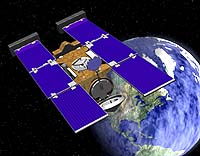
Denver CO (SPX) Jan 14, 2009 On Jan. 14, NASA's Stardust-NExT spacecraft will fly by Earth during a gravity assist maneuver that will increase its velocity and sling shot the spacecraft into an orbit to meet up with comet Tempel 1 in February 2011. Flight operations for the spacecraft are performed from Lockheed Martin's Mission Support Area in Denver, Colo. The Jet Propulsion Laboratory in Pasadena, Calif. provides the precision navigation need for the flyby and the journey to Tempel 1. The Lockheed Martin-built spacecraft's closest approach will happen at 12:33 p.m. MST as it comes within 5,690 miles (9,157 km) of Earth. At its closest point, the spacecraft will fly over the California/Mexico border south of San Diego at a speed of approximately 22,400 miles per hour (36,000 kilometer per hour). "We performed our final trajectory correction maneuver on Jan. 5 that put us into a precise position for the flyby," said Allan Cheuvront, Stardust-NExT program manager at Lockheed Martin Space Systems Company. "On Jan. 10, we sent the last set of commands to the spacecraft that it will use to perform the gravity assist maneuver. We're in great shape and we're looking forward to seeing Stardust fly by before it heads back into deep space." This isn't the first time Stardust has flown by Earth. The first was Jan. 15, 2001 when it used the Earth for a gravity assist to meet up with comet Wild 2. Five years later on Jan. 15, 2006, the spacecraft flew by Earth as it released it sample return capsule safely back to Earth; which held particles from comet Wild 2 and interstellar dust. The Stardust-NExT (New Exploration of Tempel) mission is a low-cost mission that will expand the investigation of comet Tempel 1 initiated by NASA's Deep Impact spacecraft. The mission uses the still-healthy Stardust spacecraft to perform a flyby of comet Tempel 1 and obtain high-resolution images of the coma and nucleus, as well as measurements of the composition, size distribution, and flux of dust emitted into the coma. Stardust-NExT will also provide important new information on how Jupiter family comets evolve and how they formed 4.6 billion years ago. Dr. Joseph Veverka at Cornell University is the principal investigator of the Stardust-NExT mission. JPL is managing Stardust-NExT for the NASA Science Mission Directorate, Washington, D.C. Share This Article With Planet Earth
Related Links Stardust-NExT Asteroid and Comet Mission News, Science and Technology
 NASA's Swift Looks To Comets For A Cool View
 Greenbelt MD (SPX) Dec 04, 2008
NASA's Swift Gamma-ray Explorer satellite rocketed into space in 2004 on a mission to study some of the highest-energy events in the universe. The spacecraft has detected more than 380 gamma-ray bursts, fleeting flares that likely signal the birth of a black hole in the distant universe. |
|
|

| The content herein, unless otherwise known to be public domain, are Copyright 1995-2007 - SpaceDaily.AFP and UPI Wire Stories are copyright Agence France-Presse and United Press International. ESA Portal Reports are copyright European Space Agency. All NASA sourced material is public domain. Additional copyrights may apply in whole or part to other bona fide parties. Advertising does not imply endorsement,agreement or approval of any opinions, statements or information provided by SpaceDaily on any Web page published or hosted by SpaceDaily. Privacy Statement |
 del.icio.us
 Digg
Digg Reddit
 YahooMyWeb
 Google
 Facebook