
 |
 |
 |
 |
 |
 |
 |
 |
 |

 |
Stardust Sheds New Light On Origin Of Elements Of Life
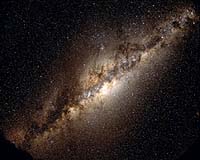
College Park MD (SPX) Mar 13, 2009 Using NASA's Spitzer Telescope, an international research team has found evidence that some stars in the center of the Milky Way galaxy have both carbon and oxygen in the dust that surrounds them, a rare combination in galactic dust. Scientists have long expected to find carbon-rich stars in our galaxy because we know that significant quantities of carbon must be created in many such stars, but carbon had not previously shown up in the clouds of gas around these stars," said Matthew Bobrowsky, an astrophysicist in the University of Maryland's department of physics and one of the authors of a paper published in the February issue of the journal Astronomy and Astrophysics. "Based on our findings, this is because medium-sized stars rich in carbon sometimes keep that carbon hidden until very near the end of their stellar lives, releasing it only with their final 'exhalations'," explained Bobrowsky, who noted that previously scientists hadn't looked for carbon around stars that were so near the end of their active lives. As a star burns hotter and hotter, the hydrogen gas that originally made up almost all of its mass is converted, through nuclear fusion, first to helium, and then to progressively heavier elements. The hottest region in the core fuses together the heaviest elements. And these can reach the surface of the star only when its life is almost over. "The Big Bang produced only hydrogen and helium," Bobrowsky said. "Heavier elements like carbon and oxygen only come from getting 'cooked up' in stars. Nuclear reactions in stars created the heavier elements found in 'life as we know it'." In the last 50,000 years of their 10 billion-year lives, sun-sized stars expel carbon atoms along with hydrogen and helium to form a surrounding cloud of gas that soon disperses into space, perhaps to eventually become the stuff of new stars, solar systems, or perhaps even life on some earth-like planet. Much larger stars expel their heavier matter in massive explosions called supernovae. "All the heavy elements [which astronomers call 'metals,' and include all elements heavier than hydrogen and helium] on Earth were created by nuclear fusion reactions in previous generations of stars," said Bobrowsky. "Those earlier stars expelled those elements into space and then our solar system formed out of that gas containing all the heavy elements that we now find in Earth and in life on Earth." The team of scientists used the Spitzer Space Telescope to view each star and its surrounding clouds of dust and particles, called a planetary nebulae. The researchers measured the light emitted by the stars and the surrounding dust and were able to identify carbon compounds based on the wavelengths of light emitted by the stars. Looking in an area at the center of the Milky Way called the "Galactic Bulge," the team observed 26 stars and their planetary nebulae and found 21 with carbon "signatures." But the scientists did not just find carbon around these stars; they also found oxygen in these 21 dust clouds, revealing a surprising mixture of ingredients for space dust. They report in their paper that this is likely due to a thermal pulse where a wave of high-pressure gas mixes layers of elements like carbon and oxygen and spews them out into the surrounding cloud. The finding of carbon and oxygen in the dust clouds surrounding stars suggests a recent change of chemistry in this population of stars, according to the authors. "Stars in the center of the Milky Way are old and 'metal-rich' with a high abundance of heavy elements," Bobrowsky said. "They are different in chemical composition than those found in the disc, farther out from the center." Studying the chemistry of these stars helps scientists learn how the matter that makes up our earth and other planets in our galaxy left its stellar birthplaces long ago. "If we want to understand how our galaxy, and the stars, planets and life in it, came to be the way they are, we need to understand the creation of the chemical elements of which they are composed," Bobrowsky said. Share This Article With Planet Earth
Related Links Spitzer Telescope Life Beyond Earth Lands Beyond Beyond - extra solar planets - news and science
 Could Life On Earth Have Come From Ceres
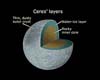 Moffett Field CA (SPX) Mar 06, 2009
Astrobiologists hope to find life elsewhere in the universe, or possibly even in our own cosmic neighborhood, the solar system. Their efforts are usually concentrated on worlds such as the planet Mars, or icy moons like Europa. |
|
|

| The content herein, unless otherwise known to be public domain, are Copyright 1995-2007 - SpaceDaily.AFP and UPI Wire Stories are copyright Agence France-Presse and United Press International. ESA Portal Reports are copyright European Space Agency. All NASA sourced material is public domain. Additional copyrights may apply in whole or part to other bona fide parties. Advertising does not imply endorsement,agreement or approval of any opinions, statements or information provided by SpaceDaily on any Web page published or hosted by SpaceDaily. Privacy Statement |
 del.icio.us
 Digg
Digg Reddit
 YahooMyWeb
 Google
 Facebook