
 |
 |
 |
 |
 |
 |
 |
 |
 |

 |
State-Of-The-Art Grating For Gaia
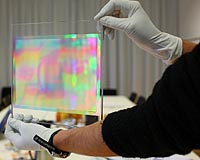
Paris, France (ESA) Feb 02, 2009 An important milestone has been reached for the Gaia Radial Velocity Spectrometer (RVS): the full-size demonstrator model of the RVS grating - a key component responsible for the dispersion of the light into constituent wavelengths - has been built by industry and was delivered to ESA last month. The Fraunhofer Institut fur Optik und Feinmechanik (IOF) in Jena (D) has designed, built and tested the demonstrator model of the grating, within the frame of a feasibility study issued by ESA. The successful manufacture of the grating is a key milestone, as it proves that the large transmission grating, with dimensions of 20.5 cm � 15.5 cm, can be built to meet the demanding requirements for the RVS. The RVS is one of the three integrated instrument functions of the Gaia payload. Part of the light collected by the large telescopes on the Gaia spacecraft will pass though the RVS to perform high-resolution spectroscopic observations of stars that pass through the field-of-view. The stellar distances derived from these data, in combination with the accurate position measurements that will also be acquired by the Gaia payload, will create a detailed three-dimensional map of our Galaxy.
Blazed gratings At specific angles the light interferes constructively and these peaks are referred to as orders. Within each order light is also dispersed by wavelength. Blazed transmission gratings have specifically designed groove cross-sections that cause most of the incident light to be transmitted into a selected order of the interference pattern. This is expressed in the efficiency, which is the ratio of the amount of light dispersed into the desired order (m=+1 for RVS) to the amount of incident light. The common groove cross-section for blazed gratings is a saw-tooth pattern in the surface layer of the grating. But the RVS grating is made with a challenging technique to realise a unique groove cross-section. This was needed to be able to meet all requirements for the RVS: the resolution for separating the constituent wavelengths must be ?/??=11 500; the grating needs to have a very small wavefront error (a measure for the deviation from a perfect surface); and the efficiency needs to be >70%.
Unique surface structure of the RVS grating Rather than the regular saw-tooth pattern for the grating cross-section, the RVS grating has a unique sequence of discrete patches with a block shape. The pattern is a repeated set of five blocks of increasingly smaller widths. The spacing between the patches as well as the width of each individual patch is smaller than the wavelengths that the RVS will study (which lie in the narrow near-infrared band between 847-874 nm). This means that at these wavelengths the light does not "see" the individual patches, but rather the integrated profile of the patches. The net effect is the same as for a regular saw-tooth pattern, but the discrete patches allow for all the optical requirements to be met, including the very high efficiency. The development of the RVS grating by IOF was tackled in two steps. In June 2008 a small-scale version was made to prove that the required pattern of sub-wavelength scale patches (called the binary index modulation structure) could be made using a challenging technique. The full-size demonstrator model was successfully created a few months later and delivered to ESA on 10 December 2008. This success now clears the way for developing the actual flight model of the blazed transmission grating that will fly onboard Gaia early in the next decade. Share This Article With Planet Earth
Related Links ESA Space Technology News - Applications and Research
 ISRO-Built Satellite Fails After Five Weeks
 Bangalore, India (PTI) Feb 02, 2009
The very first communications satellite sold by the Indian Space Research Organization (ISRO) to the European operator Eutelsat has failed abruptly after five weeks in orbit, in a setback to ISRO which just celebrated the 100th day of its successful moon mission. |
|
|

| The content herein, unless otherwise known to be public domain, are Copyright 1995-2007 - SpaceDaily.AFP and UPI Wire Stories are copyright Agence France-Presse and United Press International. ESA Portal Reports are copyright European Space Agency. All NASA sourced material is public domain. Additional copyrights may apply in whole or part to other bona fide parties. Advertising does not imply endorsement,agreement or approval of any opinions, statements or information provided by SpaceDaily on any Web page published or hosted by SpaceDaily. Privacy Statement |
 del.icio.us
 Digg
Digg Reddit
 YahooMyWeb
 Google
 Facebook