
 |
 |
 |
 |
 |
 |
 |
 |
 |

 |
Study: Increased Greenland ice melt likely
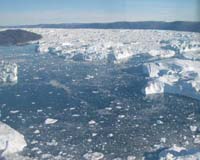
Madison, Wis. (UPI) Sep 2, 2008 U.S. scientists say an analysis of the Laurentide Ice Sheet -- the last Northern Hemisphere ice sheet to disappear -- suggests increased Greenland ice melt. Researchers at the University of Wisconsin and Columbia University's Center for Climate Systems Research said the disappearance of the Laurentide Ice Sheet is the closest example of what can be expected in Greenland during the next century. The study shows sea level rise as a result of ice sheet melt can occur very rapidly. "We have never seen an ice sheet retreat significantly or even disappear before, yet this may happen for the Greenland ice sheet in the coming centuries to millennia," said University of Wisconsin Assistant Professor Anders Carlson, who led the study. "What we don't know is the rate of melting of the Greenland ice sheet." "The word 'glacial' used to imply something was very slow," said Allegra LeGrande, who led the computer modeling portion of the study. "This new evidence �� indicates that 'glacial' is anything but slow. Past ice sheets responded quickly to a changing climate, hinting at the potential for a similar response in the future." The findings appear in the online edition of the journal Nature Geoscience. Community Email This Article Comment On This Article Share This Article With Planet Earth
Related Links Beyond the Ice Age
 Thawing permafrost may hike global warming
 Gainesville, Fla. (UPI) Sep 2, 2008
 A U.S.-led study suggests greenhouse gas emissions from previously frozen organic carbon in soil might be larger than previously believed. |
|
|

| The content herein, unless otherwise known to be public domain, are Copyright 1995-2007 - SpaceDaily.AFP and UPI Wire Stories are copyright Agence France-Presse and United Press International. ESA Portal Reports are copyright European Space Agency. All NASA sourced material is public domain. Additional copyrights may apply in whole or part to other bona fide parties. Advertising does not imply endorsement,agreement or approval of any opinions, statements or information provided by SpaceDaily on any Web page published or hosted by SpaceDaily. Privacy Statement |
 del.icio.us
 Digg
Digg Reddit
 YahooMyWeb
 Google
 Facebook