
 |
 |
 |
 |
 |
 |
 |
 |
 |

 |

Denver (UPI) Sep 21, 2010 The long-held belief that Neanderthal man developed "modern" tools only through contact with more advanced Homo sapiens is wrong, a U.S. researcher says. Julien Riel-Salvatore, assistant professor of anthropology at the University of Colorado, Denver, has challenged a half-century of conventional wisdom maintaining that Neanderthals were thick-skulled, primitive "cavemen" overrun and outcompeted by more advanced modern humans arriving in Europe from Africa, a university release says. "Basically, I am rehabilitating Neanderthals," Riel-Salvatore says. "They were far more resourceful than we have given them credit for." Riel-Salvatore identified projectile points, ochre, bone tools, ornaments and possible evidence of fishing and small game hunting at archaeological sites associated with a culture of people knows as the Uluzzian throughout southern Italy. They emerged in an area geographically separated from modern humans. "My conclusion is that if the Uluzzian is a Neanderthal culture it suggests that contacts with modern humans are not necessary to explain the origin of this new behavior," Riel-Salvatore says. "This stands in contrast to the ideas of the past 50 years that Neanderthals had to be acculturated to humans to come up with this technology," he said. "When we show Neanderthals could innovate on their own it casts them in a new light. It 'humanizes' them if you will."
earlier related report A decade of new fossil discoveries that have more than doubled the number of known tyrannosaur species has changed perceptions of the huge dinosaur with the tiny arms, a release from the American Museum of Natural History says. Older and smaller tyrannosaurs have made the evolutionary tree of this group richer and more complex, and innovative research has added an enormous amount of information about tyrannosaurs, so much so that the group could now be considered an exemplar for paleontology research, scientists say. "T. rex is the most iconic of all dinosaurs," Mark Norell, curator in the Division of Paleontology at the museum, says. "Its star power has allowed a research focus into questions not normally undertaken with fossils, questions like bone growth, biomechanics, and neurology." "We know more about tyrannosaurs than any other group of dinosaurs -- even more than some groups of living organisms," Stephen Brusatte, a graduate student affiliated with the museum, said. "Over the past year, five new species of tyrannosaurs have been described, and over the last ten years we have found the oldest and smallest members of the group," he said. "Now we can understand the family tree of tyrannosaurs in unprecedented detail. "T. rex is really just the tip of the iceberg of tyrannosaur diversity, and honestly, is quite abnormal when compared with other members of the group. For most of their evolutionary history, tyrannosaurs were small and living in the shadow of other giant apex predators," Brusatte said. "They stayed small until the end of the Cretaceous -- the final 20 million years of dinosaur history."
Share This Article With Planet Earth
Related Links All About Human Beings and How We Got To Be Here

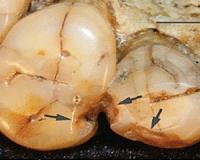 A Chip Off the Early Hominin Tooth
Tel Aviv, Israel (SPX) Sep 21, 2010 Were our early mammalian ancestors vegetarians, vegans or omnivores? It's difficult for anthropologists to determine the diet of early mammalians because current fossil analysis provides too little information. But a new method that measures the size of chips in tooth fossils can help determine the kinds of foods these early humans consumed. Prof. Herzl Chai of Tel Aviv University's School ... read more |
|
|
| The content herein, unless otherwise known to be public domain, are Copyright 1995-2010 - SpaceDaily. AFP and UPI Wire Stories are copyright Agence France-Presse and United Press International. ESA Portal Reports are copyright European Space Agency. All NASA sourced material is public domain. Additional copyrights may apply in whole or part to other bona fide parties. Advertising does not imply endorsement,agreement or approval of any opinions, statements or information provided by SpaceDaily on any Web page published or hosted by SpaceDaily. Privacy Statement |


 del.icio.us
 Digg
Digg Reddit
 YahooMyWeb
 Google
 Facebook


