
 |
 |
 |
 |
 |
 |
 |
 |
 |

 |
Study: Pterosaurs used 4 legs to lift off
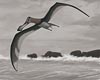
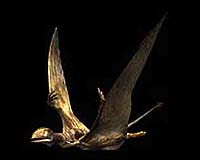
Baltimore (UPI) Jan 7, 2009 Dinosaur-era pterosaurs, often referred to as pterodactyls, used their "arms" as well as their legs to leap into flight, a computerized model suggests. In fact, pterosaurs -- believed to have died off 65 million years ago in the same cataclysm that killed off the dinosaurs on land and plesiosaurs at sea -- had much stronger "arms" than legs, which is the opposite of the way birds are built, Michael Habib, a researcher at the Johns Hopkins University medical school's Center for Functional Anatomy and Evolution, wrote in a study published in the German journal Zitteliana. "The difference between pterosaurs and birds with regard to critical mechanical properties is very, very large, especially when you're talking about the big pterosaurs," Habib said in a statement. "As the size gets bigger, the difference gets bigger too," he said. His model indicated that Quetzalcoatlus pterosaurs, for instance -- one of the largest known flying animals of all time, with a 35-foot wingspan -- couldn't possibly launch themselves using their hind legs alone. But by folding their wings and balancing on their "knuckles," they could push themselves off, almost like a leap-frogging long-jump, he said. "Then, with wings snapping out, off they'd fly," he said. "Using all four legs, it takes less than a second to get off of flat ground, no wind, no cliffs," Habib said. "This was a good thing to be able to do if you lived in the late Cretaceous period and there were hungry tyrannosaurs wandering around," he said. Habib's research was funded by the Jurassic Foundation, a non-profit organization providing funding for research on dinosaur paleobiology. Share This Article With Planet Earth
Related Links Explore The Early Earth at TerraDaily.com
 When Life On Earth Became So Big
 Blacksburg VA (SPX) Jan 05, 2009
In 3.5 billion years, life on earth went from single microscopic cells to giant sequoias and blue whales. Scientists have now documented quantitatively that the increase in maximum size of organisms was not gradual, but happened in two distinct bursts "tied to the geological evolution of the planet," said Michal Kowalewski, professor of geosciences at Virginia Tech. |
|
|

| The content herein, unless otherwise known to be public domain, are Copyright 1995-2007 - SpaceDaily.AFP and UPI Wire Stories are copyright Agence France-Presse and United Press International. ESA Portal Reports are copyright European Space Agency. All NASA sourced material is public domain. Additional copyrights may apply in whole or part to other bona fide parties. Advertising does not imply endorsement,agreement or approval of any opinions, statements or information provided by SpaceDaily on any Web page published or hosted by SpaceDaily. Privacy Statement |
 del.icio.us
 Digg
Digg Reddit
 YahooMyWeb
 Google
 Facebook