
 |
 |
 |
 |
 |
 |
 |
 |
 |

 |
Study shows sea slugs act like plants
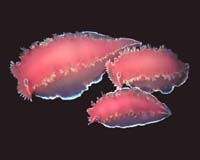
College Station, Texas (UPI) Nov 26, 2008 The sea slug is a bit of a chameleon, behaving more like a plant instead of the mollusk it is, Texas A&M University researchers found. The Elysia chlorotica acts like a plant because it has at least one gene required for photosynthesis, the process by which plants trap the sun's energy and convert it to food, said Texas A&M biology Professor James Manhart. "We found that the slug has at least one gene required for photosynthesis in its nuclear genome, which has never been found in any animal," Manhart said in a news release. "The critical thing is the plastids come from the alga but the slug nucleus contains at least one, and probably more, of the genes required for plastid functioning." These plastids remain in the slug after it eats algae, photosynthesizing and providing it food, Manhart said. The result, he said, is the creature becoming a "solar-powered" slug and capable of making its own food like plants do. "The slug needs the alga to mature and complete its life cycle," Manhart says. "It is totally dependent on the alga to survive. Once the slug has acquired a sufficient amount of plastids it can survive, like plants, for at least nine months by trapping solar energy and converting it into food." Share This Article With Planet Earth
Related Links Darwin Today At TerraDaily.com
 New Perspective On Animal Evolution
 Austin TX (SPX) Nov 26, 2008
Groove-like tracks on the ocean floor made by giant deep-sea single-celled organisms could lead to new insights into the evolutionary origin of animals, says biologist Mikhail "Misha" Matz from The University of Texas at Austin. |
|
|

| The content herein, unless otherwise known to be public domain, are Copyright 1995-2007 - SpaceDaily.AFP and UPI Wire Stories are copyright Agence France-Presse and United Press International. ESA Portal Reports are copyright European Space Agency. All NASA sourced material is public domain. Additional copyrights may apply in whole or part to other bona fide parties. Advertising does not imply endorsement,agreement or approval of any opinions, statements or information provided by SpaceDaily on any Web page published or hosted by SpaceDaily. Privacy Statement |
 del.icio.us
 Digg
Digg Reddit
 YahooMyWeb
 Google
 Facebook