
 |
 |
 |
 |
 |
 |
 |
 |
 |

 |
Submillimetre Eagle Eyes On Mauna Kea
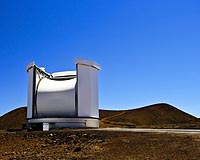
Mauna Kea HI (SPX) Nov 14, 2008 Three observatories on Mauna Kea have come together to form the world's most powerful facility for detailed submillimetre imaging. An exploratory project, the Extended SubMillimeter Array (eSMA) connects the signals from the SubMillimeter Array (SMA), consisting of eight dishes with 6-metre diameter, with those from the 15-metre James Clerk Maxwell Telescope (JCMT) and the 10-metre Caltech Submillimeter Observatory (CSO) through fibre-optic cables. During observations the signals from all ten dishes are electronically combined in a large special-purpose computer to create a virtual telescope with a diameter of 782 metres, allowing for an exceptionally sharp view. The eSMA will explore the Universe using light that the human eye cannot see, at wavelengths around 0.8 millimetre. There are many objects in the sky that emit radiation in this submillimetre range, especially the dusty regions in which new stars, planets and even entire galaxies are being born. These clouds of gas and tiny dust particles are completely dark in visible light, but submillimetre waves can penetrate them. At a dedication ceremony, Dr Louis Vertegaal of the Netherlands Organisation for Scientific Research (NWO) cut a symbolic ribbon to mark the first scientific results obtained from this historic collaboration. In the presence of dignitaries from participating organizations and the media, all 10 dishes were linked and rotated in unison. "The eSMA is an example of an international collaboration in astronomy where the result is more than the sum of its parts", says Vertegaal, Director of the Physical Sciences Department of NWO. "The partnership of three observatories on Mauna Kea has delivered a unique submillimetre facility. The first results presented here were obtained in the test phase. They show a glimpse of the discoveries we can expect with a fully commissioned eSMA on planet, star and galaxy formation." A telescope's power to see faint objects and minute details depends on the size of the surface collecting the light, either a mirror (ultraviolet to infrared wavelengths) or a dish (submillimetre to radio wavelengths). Our ability to build large collecting surfaces is limited by gravity and cost. However, a technique called interferometry allows astronomers to combine the signals from two or more telescopes to obtain an effective collecting surface given by the distance between the telescopes. In this virtual manner the telescope's size can be greatly expanded without actually building a giant dish. While this technique has been used in radio astronomy for over 50 years, it is far more challenging at shorter submillimetre wavelengths. Furthermore, the water vapour in the Earth's atmosphere blocks submillimetre radiation at all but the driest sites and highest altitudes. This makes the three submillimetre observatories at 14,000 ft (4000 m) on Mauna Kea perfect for this undertaking. Remo Tilanus, astronomer and Head of Operations of the JCMT, says: "It took a lot of hard work and dedication from the staff of the three observatories to install the special equipment and software needed to make the eSMA a reality. Seeing the first astronomical results is just fantastic." One of the first observations of the eSMA, led by Sandrine Bottinelli from Leiden Observatory, targetted a bright radio source seen through the disk of a foreground spiral galaxy. The spiral galaxy acts as a lens and magnifies and splits the light from the background source in two close images. With its sharp view, the eSMA was able to separate these two images and detect the presence of atomic carbon in the disk of the foreground spiral galaxy where it absorbed the light at a very specific frequency towards the southern image. The background radio source is located so far away that the radiation we detect from it left when the universe was only 20% of its current age. Although seen in front of the background radio source, the spiral galaxy itself is also at a large distance and the observations of the carbon in its disc tell us about the physical conditions of interstellar gas at the time the universe was only 45% of its current age. Together with complementary data on the carbon monoxide molecule, this is the first time that the ratio of carbon in atomic to molecular form can be determined accurately in such a distant galaxy. This ratio is important since it determines the ability of interstellar clouds to cool down and collapse to form new stars. Atomic carbon also plays an important role in making more complex organic molecules. "The shape of the absorption profiles suggests that we are probing different evolutionary stages of star-forming clouds. This is exciting since it could indicate whether conditions favorable for the formation of pre-biotic molecules exist in the ~6.4 billion-year old universe, as they do in our present universe.", says Bottinelli. In a second result obtained by Hiroko Shinnaga (CSO), the eSMA zoomed in on the envelope of a nearby star, called IRC+10216 or CW Leo. This star is in an evolved stage and is close to the end of its life. During this phase a star expels a lot of the gas in its outer layers to form an envelope and, by tracing the hydrogen cyanide molecule (HCN), the eSMA observed for the first time in detail the zone where molecules form from the gas and are being accelerated away. Shinnaga says: "The mass of IRC+10216 is similar to our Sun, which is expected to end its life in a similar way five billion years from now. The eSMA caught this scene with very high angular and velocity resolution, allowing for a detailed study of formation processes of the molecules and acceleration process of the molecular gas in the envelope. This material will eventually become the building blocks of new stars and new solar systems." "The eSMA will allow us to make measurements which were not previously possible", says Professor Gary Davis, Director of the JCMT. "The two scientific results obtained so far demonstrate this new capability superbly. The eSMA will enable astronomers to observe in great detail some of the sources which have been studied by the JCMT, acting alone, for the past two decades. As a consequence, we expect to enhance our understanding of the origins of planets, stars and galaxies". Share This Article With Planet Earth
Related Links Caltech Submillimeter Observatory (CSO) Space Telescope News and Technology at Skynightly.com
 IBEX Spacecraft Reaches Orbit
 San Antonio TX (SPX) Nov 13, 2008
Just over three weeks since its Oct. 19 launch, NASA's Interstellar Boundary Explorer (IBEX) spacecraft + the first mission designed to image the interaction at the edge of the solar system + concluded its orbit-raising phase and is beginning instrument commissioning in preparation to start science observations. |
|
|

| The content herein, unless otherwise known to be public domain, are Copyright 1995-2007 - SpaceDaily.AFP and UPI Wire Stories are copyright Agence France-Presse and United Press International. ESA Portal Reports are copyright European Space Agency. All NASA sourced material is public domain. Additional copyrights may apply in whole or part to other bona fide parties. Advertising does not imply endorsement,agreement or approval of any opinions, statements or information provided by SpaceDaily on any Web page published or hosted by SpaceDaily. Privacy Statement |
 del.icio.us
 Digg
Digg Reddit
 YahooMyWeb
 Google
 Facebook