
 |
 |
 |
 |
 |
 |
 |
 |
 |

 |
Successful Test In Development Of NASA's New Crew Rocket
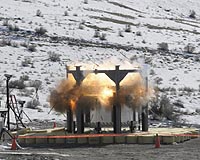
Cape Canaveral FL (SPX) Feb 02, 2009 The development of NASA's next-generation crew launch vehicle, the Ares I rocket, took another step forward Thursday as Alliant Techsystems, or ATK, successfully tested a critical piece. ATK conducted a full-scale separation test of the forward skirt extension for the Ares I-X flight test at its facility in Promontory, Utah. The Ares I-X test launch is scheduled to lift off from NASA's Kennedy Space Center in Florida during 2009. The rocket will climb about 25 miles in altitude during a two-minute powered flight. The launch will culminate with a test of the separation of the first stage from the rocket and deployment of the accompanying parachute system that will return the first stage to Earth for data and hardware recovery. Yesterday's test simulated the separation event that will take place following the first stage flight of Ares I-X. During the Ares I-X flight, the booster will separate at the frustum, a cone-shaped piece that attaches the first stage to the larger diameter upper stage. "The Ares I-X team is pleased with the completion of this key test that will provide important data leading up to the launch of the Ares I-X flight," said Steve Davis, deputy mission manager for the Ares I-X test flight at NASA's Marshall Space Flight Center in Huntsville, Ala. At an altitude of about 15,000 feet, the nose cone will be jettisoned, deploying the pilot parachute. The pilot chute will, in turn, deploy the drogue parachute, which will re-orient the booster vertically and slow it to acceptable conditions for main parachute deployment. At about 4,000 feet, the separation at the base of the forward skirt extension occurs, pulling out the three main chutes packed inside. Test objectives included demonstrating that the linear shaped charge used to separate the forward skirt extension severed cleanly and measuring the shock created by that charge. The data will be used to analyze the system and prepare for the Ares I-X flight test and the development of the Ares I crew launch vehicle. The forward skirt extension is built to withstand the loads of the first stage and support the weight of the upper stage. The component is built as one solid piece of aluminum forged into a 6-foot-long by 12-foot-diameter cylinder with a unique internal support structure that houses three newly-designed main parachutes. Its state-of-the-art design will withstand the force imparted at main chute deployment. "This was an important milestone for the program, as it validates key parameters to support the upcoming Ares I-X flight test," said Mike Kahn, executive vice president of ATK Space Systems. "The program is one step closer to the flight test of Ares I-X." Share This Article With Planet Earth
Related Links Ares Program Space Tourism, Space Transport and Space Exploration News
 Weightless Students Test Personal Navigation Aid For Spaceflight
 Houston TX (SPX) Jan 30, 2009
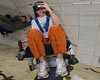
Many people resolved to lose weight this year, but seven university students had a different goal - to be "weightless." The students served as both investigators and test subjects in an experiment to examine how a person's sense of direction is impacted by the lack of gravity and whether a simple device can improve the ability to navigate. The student activity, supported by funds from National Space Biomedical Research Institute (NSBRI) and Excalibur Almaz, was conducted through NASA's Reduced Gravity Student Flight Program. |
|
|

| The content herein, unless otherwise known to be public domain, are Copyright 1995-2007 - SpaceDaily.AFP and UPI Wire Stories are copyright Agence France-Presse and United Press International. ESA Portal Reports are copyright European Space Agency. All NASA sourced material is public domain. Additional copyrights may apply in whole or part to other bona fide parties. Advertising does not imply endorsement,agreement or approval of any opinions, statements or information provided by SpaceDaily on any Web page published or hosted by SpaceDaily. Privacy Statement |
 del.icio.us
 Digg
Digg Reddit
 YahooMyWeb
 Google
 Facebook