
 |
 |
 |
 |
 |
 |
 |
 |
 |

 |
Super Explosion In 16th Century Caught By Subaru
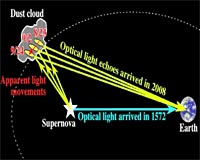
Hilo HI (SPX) Dec 04, 2008 When a person looks up into the nighttime sky, they see stars, planets, and galaxies across a sea of darkness. The movements of planets and seasonal variations to the constellations have been relatively the same for thousands of years. What if the sky changed overnight and a new star brighter than anything else appeared? Would it be noticed if it happened in the 16th century? A few months ago astronomers at the Subaru Telescope went back in time and observed light from a "new star" that originally was seen on 11 November 1572 by astronomer Tycho Brahe and others. What Brahe observed as a bright star in the constellation Cassiopeia, outshining even Venus, was actually a rare supernova event where the violent death of a star sends out an extremely bright outburst of energy. He studied the brightness and color of the "new star" until March 1572 when it faded from view. The remains of this milestone event are seen today as Tycho's supernova remnant (see Reference Figure). A team of international astronomers recently completed a study at Subaru that focused on 'light echoes' from Tycho's supernova to determine its origin and exact type, and relate that information to what we see from its remnant today. A 'light echo' is light from the original supernova event that bounces off dust particles in surrounding interstellar clouds and reaches Earth many years after the direct light passes by; in this case, 436 years ago. This same team used similar methods to uncover the origin of supernova remnant Cassiopeia A in 2007. Lead project astronomer at Subaru, Dr. Tomonori Usuda, said "using light echoes in supernova remnants is time-travelling in a way, in that it allows us to go back hundreds of years to observe the first light from a supernova event. We got to relive a significant historical moment and see it as famed astronomer Tycho Brahe did hundreds of years ago. More importantly, we get to see how a supernova in our own galaxy behaves from its origin." On 24 September 2008, using the Faint Object Camera and Spectrograph (FOCAS) instrument at Subaru, the light echoes were broken apart into the signatures of atoms (spectra) present when Supernova 1572 exploded, bearing all the information about the nature of the original blast. The results showed clear absorption of once-ionized silicon and absence of the hydrogen H-alpha emission. The findings were very typical of a Type Ia supernova observed at maximum brightness of its outburst. During the study, the astronomers tested theories of the explosion mechanism and the nature of the supernova progenitor. For Type Ia supernovae, a white dwarf star in a close binary system is the typical source, and as the gas of the companion star accumulates onto the white dwarf, the white dwarf is progressively compressed, and eventually sets off a runaway nuclear reaction inside that eventually leads to a cataclysmic supernova outburst. However, as Type Ia supernovae with luminosity brighter/fainter than standard ones have been reported recently, the understanding of the supernova outburst mechanism has come under debate. In order to explain the diversity of the Type Ia supernovae, the Subaru team studied the outburst mechanisms in detail. What they discovered is that Supernova 1572 shows indications of an aspherical/nonsymmetrical explosion, which, in turn, puts limits on explosion models for future studies. In addition, follow-up comparisons with template spectra of Type Ia supernovae found outside our Galaxy shows that Tycho's supernova belongs to the majority class of Normal Type Ia, and, as such, is now the first confirmed and precisely classified supernova in our galaxy. This finding is significant because Type Ia supernovae are the primary source of heavy elements in the Universe, and play an important role as cosmological distance indicators, serving as 'standard candles' because the level of the luminosity is always the same for this type of supernova. This observational study at Subaru established how light echoes can be used in a spectroscopic manner to study supernovae outburst that occurred hundreds of years ago. The light echoes, when observed at different position angles from the source, enabled the team to look at the supernova in a three dimensional view. For the future, this 3D aspect will accelerate the study of the outburst mechanism of supernova based on their spatial structure, which, to date, has been impossible with distant supernovae in galaxies outside the Milky Way. Share This Article With Planet Earth
Related Links Subaru Telescope Space Telescope News and Technology at Skynightly.com
 Astronomical Collaboration Expected On Antarctic And Space Telescopes
 Beijing (XNA) Nov 20, 2008
A world leading astronomer said Wednesday that international collaboration on building new, powerful telescopes in Antarctica and space would trigger major breakthroughs in scientific research. |
|
|

| The content herein, unless otherwise known to be public domain, are Copyright 1995-2007 - SpaceDaily.AFP and UPI Wire Stories are copyright Agence France-Presse and United Press International. ESA Portal Reports are copyright European Space Agency. All NASA sourced material is public domain. Additional copyrights may apply in whole or part to other bona fide parties. Advertising does not imply endorsement,agreement or approval of any opinions, statements or information provided by SpaceDaily on any Web page published or hosted by SpaceDaily. Privacy Statement |
 del.icio.us
 Digg
Digg Reddit
 YahooMyWeb
 Google
 Facebook