
 |
 |
 |
 |
 |
 |
 |
 |
 |

 |
Swords and Shields: Iran's ICBM threat
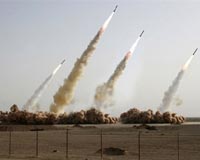
Washington (UPI) April 3, 2009 The Islamic Republic of Iran produces several short-range rockets domestically, including the Shahab-1 and the Shahab-2. They are spin-offs respectively of the Soviet-built Scud-B and Scud-C. It also produces a 1,300 kilometer-range -- 780 miles -- single-stage liquid-fueled ballistic missile Shahab-3 that is a spin-off of North Korea's relatively reliable No-dong intermediate-range ballistic missile. Details of these systems can be found at nti.org/e_research/profiles/Iran/index.html. Iran remains committed to developing a long-range ICBM that can extend Tehran's military reach to Europe and the United States. The Middle East, Europe and even the Eastern Seaboard of the United States may find themselves within range of Iranian nuclear missiles in the next three to five years or less. Even in case of a conventional intercontinental ballistic missile -- ICBM -- launch from Iran, the warheads could reach the U.S. mainland within approximately 33 minutes, as described in The Heritage Foundation's new documentary trailer on the missile threat. It can be accessed at eritage.org/33-minutes/index.htm. That leaves precious little time for preparedness, and there is not a functional anti-ballistic missile -- ABM -- defense system in place on the Eastern Seaboard or in Europe to stop such an attack. President George W. Bush and his administration arranged for missile defenses designed to shoot down individual or small-scale ICBM attacks to be installed in Central Europe, but the new Obama administration has signaled it may scrap those plans as a sop to Russia. The long-range ballistic missiles of Iran and North Korea demonstrate that missile defenses in Eastern Europe and East Asia address a real threat and are not aimed at Russia, as the Kremlin keeps alleging. Indeed, Iran's recent steps should serve as a wake-up call for Moscow, despite its long-time ties with Tehran. Russia should finally be able to see that the threat from "rogue states" with nuclear weapons and long-range ICBM is real. But the Kremlin appears to be still blinkered by its narrow geopolitical and power projection interests. Its offer to let the United States use its new early warning station at Armavir and an old one in Qabala, Azerbaijan, is no substitute for a real defense. They may only help the United States to detect the launch, but do nothing to impede their flight to the targets. These are early warning stations. One of them, Qabala is over 30 years old. They lack capabilities for intercepting ballistic missiles. In addition, Azerbaijan President Ilham Aliyev announced on March 11 that Azerbaijan will not lease Qabala to the United States. At the time when Iran's missile program advances become obvious, doubt and delay in deploying the elements of ballistic missile defense in Poland and Czech Republic could not be more dangerous. U.S. President Barack Obama may be hoping for a change in Iran's foreign policy if Mohammad Khatami regains Iran's presidency in the upcoming June 2009 election. However, first, it is the Supreme Leader, Ayatollah Ali Khamenei, who controls Iran's foreign and defense policy. And second, even if that happens, Washington foot-dragging on missile defense will have cost precious time and signaled weakness. The adversaries of the United States would likely interpret that as a signal to push forward, not pull back. (Ariel Cohen, Ph.D., is a Senior Research Fellow in Russian and Eurasian Studies and International Energy Security at the Kathryn and Shelby Cullom Davis Institute at The Heritage Foundation.) Share This Article With Planet Earth
Related Links Learn about nuclear weapons doctrine and defense at SpaceWar.com Learn about missile defense at SpaceWar.com All about missiles at SpaceWar.com Learn about the Superpowers of the 21st Century at SpaceWar.com
 Analysis: Russia to modernize army, nukes
 Berlin (UPI) Mar 18, 2009
 President Dmitry Medvedev said Russia would modernize its armed forces and nuclear weapons to counter the North Atlantic Treaty Organization's eastward expansion, but experts say the West does not have to worry about a new crisis with Moscow. |
|
|

| The content herein, unless otherwise known to be public domain, are Copyright 1995-2007 - SpaceDaily.AFP and UPI Wire Stories are copyright Agence France-Presse and United Press International. ESA Portal Reports are copyright European Space Agency. All NASA sourced material is public domain. Additional copyrights may apply in whole or part to other bona fide parties. Advertising does not imply endorsement,agreement or approval of any opinions, statements or information provided by SpaceDaily on any Web page published or hosted by SpaceDaily. Privacy Statement |
 del.icio.us
 Digg
Digg Reddit
 YahooMyWeb
 Google
 Facebook