
 |
 |
 |
 |
 |
 |
 |
 |
 |

 |
Team Develops New Metamaterial Device
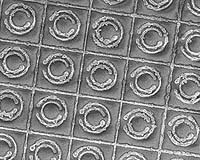
Chestnut Hill MA (SPX) Feb 25, 2009 An engineered metamaterial proved it can function as a state-of-the-art device in the complex terahertz range of the electromagnetic spectrum, setting a standard of performance for modulating tiny waves of radiation, according to a team of researchers from Boston College, the Los Alamos and Sandia national laboratories, and Boston University. An electrical current applied to the metamaterial - a hybrid structure of metallic split-ring resonators - controlled the phase of a terahertz (THz) beam 30 times faster and with far greater precision than a conventional optical device, the researchers report in the current online edition of the journal Nature Photonics. The discovery marks a milestone in the use of metamaterials and terahertz radiation, a safe, non-ionizing frequency that is the subject of a growing body of research and viewed as a promising component in applications that include advanced security screening systems and imaging technologies. "This is a true metamaterial device," Boston College Asst. Prof. of Physics Willie J. Padilla, one of the co-authors of the paper, said. "This highlights the fact that you can make solid state devices at terahertz frequencies with metamaterials." Constructed on the micron-scale, metamaterials are composites that use unique metallic contours in order to produce responses to light waves, giving each metamaterial its own unique properties beyond the elements of the actual materials in use. Within the past decade, researchers have sought ways to significantly expand the range of material responses to waves of electromagnetic radiation - classified by increasing frequency as radio waves, microwaves, terahertz radiation, infrared radiation, visible light, ultraviolet radiation, X-rays and gamma rays. These metamaterials have demonstrated numerous novel effects that defy accepted electromagnetic principles. Previously, in systems known as THz time domain spectrometers, the flow of terahertz radiation has been modulated indirectly by optical choppers, mechanical devices that either blocked a laser or allowed it to pass through. This "all or nothing" approach - similar to opening and closing the shutter of a camera - limits the speed with which one can manipulate terahertz waves since the chopper's mechanical components are too slow, Padilla says. The metamaterial devised by the research team electronically controlled the flow of terahertz radiation over roughly 70 percent of the frequency band - not simply at the points of maximum or minimum frequency. "We can apply an electronic signal to this device, thus making it opaque to stop terahertz, or transparent to allow terahertz through," Padilla said. "Eventually, you can turn it on and off very quickly - and that allows you to modulate the beam at a very specific frequency." Because the metamaterial device is solid-state, eliminating moving parts, it is 30 times faster than the optical chopper, according to the report, co-authored by Hou-Tong Chen, Abul K. Azad and Antoinette J. Taylor of Los Alamos National Laboratory, Michael J. Cich of Sandia National Laboratories and Richard D. Averitt of Boston University "The advantage of the metamaterial is you are doing it electronically," Padilla said. "If you want to build a device, the advantage of this is that it is all solid-state and voltage controlled. You have no moving parts. Therefore, you can modulate at very high speeds." These kinds of controls have been developed for microwave and optical frequencies and led to a number of key breakthroughs, the researchers note. But the technologies have not extended to the terahertz frequency. Padilla said a solid-state metamaterial device is a critical step toward improved terahertz devices, such as cameras or scanners. "What we've shown with this metamaterial is that it is now improved to the point where it could be used as a device," Padilla said. "It could be the device you could use to build a terahertz system." Share This Article With Planet Earth
Related Links Boston College Space Technology News - Applications and Research
 Heating Gold Makes It Harder Not Softer
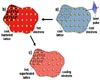 Toronto, Canada (SPX) Jan 23, 2009
Common sense tells us that when you heat something up it gets softer, but a team of researchers, led by University of Toronto chemistry and physics professor R.J. Dwayne Miller, has demonstrated the exact opposite. Their findings will be published online in the prestigious international journal Science. |
|
|

| The content herein, unless otherwise known to be public domain, are Copyright 1995-2007 - SpaceDaily.AFP and UPI Wire Stories are copyright Agence France-Presse and United Press International. ESA Portal Reports are copyright European Space Agency. All NASA sourced material is public domain. Additional copyrights may apply in whole or part to other bona fide parties. Advertising does not imply endorsement,agreement or approval of any opinions, statements or information provided by SpaceDaily on any Web page published or hosted by SpaceDaily. Privacy Statement |
 del.icio.us
 Digg
Digg Reddit
 YahooMyWeb
 Google
 Facebook