
 |
 |
 |
 |
 |
 |
 |
 |
 |

 |
Telescopes Catch Flares From Black Hole In Milky Way
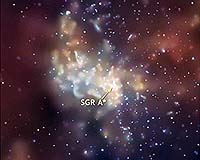
Paris, France (SPX) Nov 19, 2008 Astronomers have used two different telescopes simultaneously to study the violent flares from the supermassive black hole in the centre of the Milky Way. They have detected outbursts from this region, known as Sagittarius A, which reveal material being stretched out as it orbits in the intense gravity close to the central black hole. The team of European and US astronomers used ESO's Very Large Telescope (VLT) and the Atacama Pathfinder Experiment (APEX) telescope, both in Chile, to study light from Sagittarius A- at near-infrared wavelengths and the longer submillimetre wavelengths respectively. This is the first time that astronomers have caught a flare with these telescopes simultaneously. The telescopes' location in the southern hemisphere provides the best vantage point for studying the Galactic Centre. "Observations like this, over a range of wavelengths, are really the only way to understand what's going on close to the black hole," says Andreas Eckart of the University of Cologne, who led the team. Sagittarius A- is located at the centre of our own Milky Way Galaxy at a distance from Earth of about 26 000 light-years. It is a supermassive black hole with a mass of about four million times that of the Sun. Most, if not all, galaxies are thought to have a supermassive black hole in their centre. "Sagittarius A- is unique, because it is the nearest of these monster black holes, lying within our own galaxy," explains team member Frederick K. Baganoff of the Massachusetts Institute of Technology (MIT) in Cambridge, USA. "Only for this one object can our current telescopes detect these relatively faint flares from material orbiting just outside the event horizon." The emission from Sagittarius A- is thought to come from gas thrown off by stars, which then orbits and falls into the black hole. Making the simultaneous observations required careful planning between teams at the two telescopes. After several nights waiting at the two observatory sites, they struck lucky. "At the VLT, as soon as we pointed the telescope at Sagittarius A- we saw it was active, and getting brighter by the minute. We immediately picked up the phone and alerted our colleagues at the APEX telescope," says Gunther Witzel, a PhD student from the University of Cologne. Macarena Garcia-Mar�n, also from Cologne, was waiting at APEX, where the observatory team had made a special effort to keep the instrument on standby. "As soon as we got the call we were very excited and had to work really fast so as not to lose crucial data from Sagittarius A. We took over from the regular observations, and were in time to catch the flares," she explains. Over the next six hours, the team detected violently variable infrared emission, with four major flares from Sagittarius A- . The submillimetre-wavelength results also showed flares, but, crucially, this occurred about one and a half hours after the infrared flares. The researchers explain that this time delay is probably caused by the rapid expansion, at speeds of about 5 million km/h, of the clouds of gas that are emitting the flares. This expansion causes changes in the character of the emission over time, and hence the time delay between the infrared and submillimetre flares. Although speeds of 5 million km/h may seem fast, this is only 0.5% of the speed of light. To escape from the very strong gravity so close to the black hole, the gas would have to be travelling at half the speed of light - 100 times faster than detected - and so the researchers believe that the gas cannot be streaming out in a jet. Instead, they suspect that a blob of gas orbiting close to the black hole is being stretched out, like dough in a mixing bowl, and this is causing the expansion. The simultaneous combination of the VLT and APEX telescopes has proved to be a powerful way to study the flares at multiple wavelengths. The team hope that future observations will let them prove their proposed model, and discover more about this mysterious region at the centre of our Galaxy. Share This Article With Planet Earth
Related Links Atacama Pathfinder Experiment (APEX) Understanding Time and Space
 Black Holes Beat At The Hearts Of Galaxies
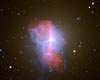 Ann Arbor MI (SPX) Nov 19, 2008
The powerful black holes at the center of massive galaxies and galaxy clusters act as hearts to the systems, pumping energy out at regular intervals to regulate the growth of the black holes themselves, as well as star formation, according to new data from NASA's Chandra X-Ray Observatory. |
|
|

| The content herein, unless otherwise known to be public domain, are Copyright 1995-2007 - SpaceDaily.AFP and UPI Wire Stories are copyright Agence France-Presse and United Press International. ESA Portal Reports are copyright European Space Agency. All NASA sourced material is public domain. Additional copyrights may apply in whole or part to other bona fide parties. Advertising does not imply endorsement,agreement or approval of any opinions, statements or information provided by SpaceDaily on any Web page published or hosted by SpaceDaily. Privacy Statement |
 del.icio.us
 Digg
Digg Reddit
 YahooMyWeb
 Google
 Facebook