
 |
 |
 |
 |
 |
 |
 |
 |
 |

 |
Ten Years In Space: The International Space Station
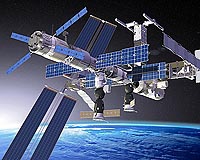
Bonn, Germany (SPX) Nov 19, 2008 On 20 November 1998, a Russian Proton rocket lifted off from the Baikonur Cosmodrome for a historic mission: It was carrying the first module of the International Space Station ISS, named Zarya (Russian for "Dawn"). This cargo and control module, which weighs about 20 tonnes and is almost 13 metres long, provides electrical power, propulsion, flight path guidance and storage space. The launch of the module, also known as FGB (the Russian acronym for "Functional Cargo Block"), heralded a new era in space exploration, as, for the first time ever, lasting cooperation in space was achieved between Russia, the US, Europe, Canada and Japan. Over the next ten years, many other modules were brought into orbit, and ISS developed into the largest human outpost in space. Since that time, the building blocks, transported by Russian launch vehicles or the US Space Shuttle, have expanded the ISS to the size of a soccer pitch and a current total mass of about 300 tonnes.
Competition in space replaced by a spirit of international cooperation In 1988, this so-called "unprecedented contract" entered the history of space exploration as one of the most extensive documents relating to international cooperation. Following the end of the Cold War, a spirit of international cooperation replaced the space race in which the two superpowers, the US and Russia, had been engaged up to that point. In 1993, the US invited Russia to join the International Space Station programme. Russia could not just contribute its immense wealth of experience, gained through operating its own MIR space station, but it could also provide "Proton" and "Soyuz" launch vehicles in order to supply the ISS and transport its crews. In the 1990s, Western scientists were already using the Russian MIR space station for numerous joint experiments.
September 2000: The first crew arrives The ISS has already become the largest "artificial" celestial object - inside, it has about the same amount of space as a jumbo jet. On its completion, scheduled for 2010, the ISS will consist of six research laboratories, two accommodation units, an observation cupola, a large number of storage areas, connecting nodes, docking devices and robotic arms.
April 2001: The first European on board In the summer of 2006, Thomas Reiter of Germany started a new chapter by setting off for the ISS as the first European astronaut to undertake a long-duration mission to the space station, spending almost six months on board in the context of the "Astrolab" mission in order to conduct more than 30 scientific experiments in addition to performing maintenance and service work. For the first time, European scientists were able to compile a research programme specifically designed to utilise the possibilities offered by the ISS, and to implement it over a longer period of time. Moreover, "Astrolab" was the first long-duration mission of ESA that was coordinated by the Columbus Control Centre at DLR in Oberpfaffenhofen.
Europe's main contribution to research and provisioning - the Columbus space laboratory and the ATV supply spacecraft Led by EADS Astrium in Bremen, 41 companies from 14 different countries were involved in developing "Columbus". Since the space laboratory was taken into operation, about 40 German experiments have been started, and in some cases they have already been completed. This was made possible not least by successful intergovernmental cooperation, both between DLR's Space Agency (DLR Raumfahrt-Agentur) and the ISS partners and between ESA member states. In April 2008, the European ATV supply spacecraft (Automated Transfer Vehicle) fully automatically docked to the ISS for the first time, carrying a payload of 7.5 tonnes. The purpose of this spacecraft, called "Jules Verne", was to re-boost the ISS in its orbit and to supply the space station with food, fresh water, clothes, oxygen as well as technical equipment for experimentation and ISS maintenance. It was subsequently used as a storage and sleeping area, before undocking in September 2008 in order to burn up almost completely in the atmosphere during re-entry, carrying a full load of waste. The plan is to send an ATV to the ISS once every 18 months in order to ensure the station's continued operation.
Germany - foremost European ISS partner DLR's Space Agency coordinates the German activities within ESA's ISS programmes related to the construction, operation and use of the station. Germany contributes, among other things: - the Columbus research laboratory - the development of the ATV supply spacecraft (Automated Transfer Vehicle) - the planning and execution of the utilisation and operation programme, including astronaut deployment - the operation of the Columbus Control Centre in Oberpfaffenhofen - the data management system for the Russian Zarya module - the robotic arm (ERA) for the Russian section of the space station German scientists have been involved since the scientific operation of the space station started in 2001. Since that time they have accomplished numerous single and serial experiments on board the ISS. These experiments concerned health research (research into the human equilibrium, immune and circulatory systems in weightlessness), growing protein crystals, fundamental physics (plasma research) as well as biological questions.
Showing the way for research and industry The plan is to develop the European space laboratory "Columbus" into a major research facility in Earth orbit in the future, making it available for non-space-related companies as well. Such companies are increasingly interested in using weightlessness in the development of process technologies and products. Through the "GoSPace" initiative, especially small and medium-sized enterprises are to be given the opportunity to conduct research on board the ISS. Share This Article With Planet Earth
Related Links Ten years of the ISS in pictures German Aerospace Center (DLR) Station at NASA Station and More at Roscosmos S.P. Korolev RSC Energia Watch NASA TV via Space.TV Space Station News at Space-Travel.Com
 Astronauts begin first spacewalk of Endeavour mission
 Washington (AFP) Nov 18, 2008
Two astronauts from NASA's space shuttle Endeavour stepped outside the International Space Station Tuesday on the first of four planned spacewalks of the 15-day mission. |
|
|

| The content herein, unless otherwise known to be public domain, are Copyright 1995-2007 - SpaceDaily.AFP and UPI Wire Stories are copyright Agence France-Presse and United Press International. ESA Portal Reports are copyright European Space Agency. All NASA sourced material is public domain. Additional copyrights may apply in whole or part to other bona fide parties. Advertising does not imply endorsement,agreement or approval of any opinions, statements or information provided by SpaceDaily on any Web page published or hosted by SpaceDaily. Privacy Statement |
 del.icio.us
 Digg
Digg Reddit
 YahooMyWeb
 Google
 Facebook