
 |
 |
 |
 |
 |
 |
 |
 |
 |

 |

Bethesda MD (SPX) Oct 19, 2010 Some 50 years ago, when the first artificial satellite was launched, it was generally thought the Earth was spherical in shape. Of course, the existence of surface anomalies such as mountains, valleys and ocean floor contours were well known, but not well understood in terms of their effects on satellite orbits near the Earth. Studies of the moon's motion had given some indication that the Earth's mass distribution is not quite spherical, but the moon is far from the planet and anomalies tend to be attenuated at long distances. As more low-Earth satellites were launched in the 1960s and 70s, precision tracking studies led to a better understanding of how the Earth's mass distribution impacts satellite orbits. Gravity models were refined and new insights were developed about how best to deal with gravity anomalies. Today, these non-spherical elements of Earth's gravity field are well understood and used to design many space missions. Noting that the geodetic shape of the Earth does not represent the gravitational field shape, we can summarize the non-spherical elements of Earth's gravity as follows. If the Earth had a uniformly homogenous mass distribution, it would have to be slightly bulging at the equator and slightly oblate about the equator. In other words, the Earth can be thought of as a basketball that is unevenly bulging about its waist. While the non-spherical elements are small they do have profound implications on how we conduct many space missions. One important result was the discovery of sun-synchronous orbits, i. e., orbits that combine altitude and inclination in such a way that satellites in these orbits repeat passes over any given point on the Earth's surface at the same local mean solar time. This is desirable for satellites such as those used for earth observations, because the surface illumination angle will be the same every time such a satellite passes overhead. Consistent lighting offers real advantages for satellites that image terrestrial locations. Non-spherical elements of the gravity field can also be detrimental for certain orbital missions. One important example is the gravity-induced east-west drift of geostationary satellites. Such satellites are placed in an equatorial orbit that matches the Earth's rotation rate, thus, rendering them "stationary" relative to the Earth. If there were no perturbing forces, these satellites would naturally remain stationary. Unfortunately, this is not the case. The non-circular shape of the equatorial gravity field causes geostationary satellites to drift to the east or to the west, depending on their chosen longitudinal location. Overall, perturbing gravitational and non-gravitational forces have a variety of important implications for space missions. In order to better understand space mission design and orbital mechanics, consider Launchspace's courses on these topics.
Share This Article With Planet Earth
Related Links Launchspace The Physics of Time and Space

 Putting A Spin On Light And Atoms
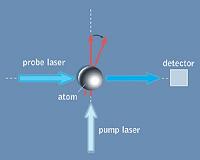
Berkeley CA (SPX) Sep 21, 2010 Magnetometers come in many shapes and sizes - an ordinary hand-held compass is the simplest - but alkali-vapor magnetometers are extrasensitive devices that measure magnetic fields using light and atoms. They can detect archaeological remains and mineral deposits underground by their faint magnetic signatures, among a host of other scientific applications. Researchers from the U.S. Departm ... read more |
|
|
| The content herein, unless otherwise known to be public domain, are Copyright 1995-2010 - SpaceDaily. AFP and UPI Wire Stories are copyright Agence France-Presse and United Press International. ESA Portal Reports are copyright European Space Agency. All NASA sourced material is public domain. Additional copyrights may apply in whole or part to other bona fide parties. Advertising does not imply endorsement,agreement or approval of any opinions, statements or information provided by SpaceDaily on any Web page published or hosted by SpaceDaily. Privacy Statement |


 del.icio.us
 Digg
Digg Reddit
 YahooMyWeb
 Google
 Facebook


