
 |
 |
 |
 |
 |
 |
 |
 |
 |

 |
The End Of Denial
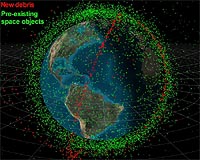
Bethesda MD (SPX) Apr 21, 2009 For the past 50 years artificial satellites and launch vehicles have created an ever growing number of orbiting debris objects, from a few microns to several meters in size. We have finally reached a state in which debris collisions are a serious concern. A number of international agreements on limiting the growth rate of debris have been affirmed. Several national and international organizations have been studying debris dynamics and predictions of close conjunctions between active satellites and space junk. Satellite operators are becoming more concerned about future incidents like the collision of Iridium 33 and Cosmos 2251. Insurers are pondering the impact of debris on risk and contemplating premium increases. Legal scholars are studying the many liability issues related to orbital collisions. Policy experts are researching the need for a new set of edicts affecting debris mitigation issues and future space program implications. Even with all these diverse interests, one thing remains clear: denial about what really has to be done is widespread. Few, if any, decision-makers have started to come to grips with the reality of the situation. Policy makers, government agencies and international working groups are focused on debris avoidance, satellite shielding and minimizing future debris generation from new satellites. Space-faring nations of the world have opened a Pandora's Box of space debris evils, and it is already too late to stop the consequences. The US, Russia (and the former Soviet Union), Europe and China have been most responsible for polluting near-Earth orbital space without regard for the potential negative long-term effects. Even though many have refused to admit it, on February 10, 2009, we received the space debris wake-up call. Two spacecraft collided. This was not simply an incident in which a piece of space junk damaged an operational satellite. It was a catastrophic collision of two whole satellites, both of which were obliterated. Iridium lost one of its 66 needed satellites, resulting in a partial loss of service to customers. Fortunately, there was a space satellite available to replace satellite number 33. We must ask the question: "Will additional satellite-killing collisions occur in the future?" The answer is, "Absolutely yes." The real question is: "When?" No one knows that answer. It could happen in a week, a month, a year, or a decade. The time to the next catastrophic event is likely to be less than 20 years. Some experts say it will happen in less than 10 years. There is a great deal of uncertainty about the timing, but there is little uncertainty about the long-term impact of unharnessed space debris. Even if all space launches are halted immediately, space will become inaccessible and unusable for mankind unless something is done to control existing debris. Until recently no one has seriously addressed the challenges of reversing the debris effects. WE at Launchspace have accepted the task of educating the space community about the future of space flight and what can be done to assure continued space utilization for the benefit of mankind. Over the past several months much research and analysis have been carried with the objective of creating a unique, timely and important seminar on space debris issues and solutions. This is the first of its kind and it will be available to the space community at a special presentation in Washington, DC on August 4, 2009. Who Should Attend: + Space industry and government executives and decision makers + Satellite program managers + Launch vehicle and satellite insurance underwriters + Space policy writers and lawyers + Anyone wishing to gain insight into the space debris issues Topics to be discussed: + The nature and history of orbital debris and the space environment + Debris propagation methods and collision events + Debris management and mitigation approaches + Methods of spacecraft protection + The ultimate solution: a debris reduction program + Costs associated with the debris hazard + Policy, legal and risk implications Share This Article With Planet Earth
Related Links Launchspace Space Technology News - Applications and Research
 Space debris: Europe to set up monitor in 'two or three years'
 Darmstadt, Germany (AFP) April 2, 2009
The European Space Agency (ESA) hopes to start monitoring orbital debris within the next few years, an official said Thursday at the close of the largest-ever conference on a worsening space peril. |
|
|

| The content herein, unless otherwise known to be public domain, are Copyright 1995-2007 - SpaceDaily.AFP and UPI Wire Stories are copyright Agence France-Presse and United Press International. ESA Portal Reports are copyright European Space Agency. All NASA sourced material is public domain. Additional copyrights may apply in whole or part to other bona fide parties. Advertising does not imply endorsement,agreement or approval of any opinions, statements or information provided by SpaceDaily on any Web page published or hosted by SpaceDaily. Privacy Statement |
 del.icio.us
 Digg
Digg Reddit
 YahooMyWeb
 Google
 Facebook