
 |
 |
 |
 |
 |
 |
 |
 |
 |

 |
The F-22 A Qualitative Not Quantitative Choice Part Two
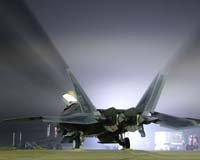
Arlington, Va. (UPI) Mar 16, 2009 Deterrence isn't in the daily headlines when Afghanistan and Iraq loom large, but behind the scenes, it's become a big preoccupation for the national-security leaders of the United States in the last few years. The likelihood is that in the coming years deterrence will put much more emphasis on America's airpower and on the Lockheed Martin/Boeing F-22 Raptor, for the Raptor is the one fighter designed to make sure U.S. forces can always do their appointed tasks from surveillance to strike. Deterrence is all about influencing a potential aggressor's cost-benefit calculation. In the Cold War, nuclear deterrence was called the balance of terror. Of course, the threat levels have changed, and arms-control agreements allow smaller numbers of nuclear warheads. However, the United States armed forces keep nuclear-armed bombers and submarines ready for alert, along with several hundred nuclear-armed intercontinental ballistic missiles. However, today's challenges are different from those of the Cold War era. What is emerging is how conventional deterrence may dominate the U.S. government's hard- and soft-power options in the years ahead. Just look at the landscape. Russia has been engaging in Cold War-style antics. China's "peaceful rise" policy is buttressed by its military buildup. Many nations are pursuing sophisticated technologies from stealthy unmanned systems to advanced air defenses capable of finding and destroying targets 100 miles away. Rogue states are getting closer to nuclear-weapons arsenals of their own, and most already have significant conventional forces. As Adm. Michael G. Mullen, chairman of the U.S. Joint Chiefs of Staff, put it: "It is way past time to re-examine our strategic thinking about deterrence." Mullen made the comments in his article "From the Chairman: It's Time for a New Deterrence Model," in the fall 2008 issue of the Joint Forces Quarterly. Conventional deterrence is a concept that needs to be defined. It is the ability of one nation -- or a group of allies -- to show they have and will use stronger forces to make sure an aggressor state can't achieve its ends. Calculation is everything, so conventional deterrence works only when aggressors are certain that they can't get away with what they are contemplating because they will be stopped cold by superior force. Airpower is one of the important tools for conventional deterrence. It is certainly a credible instrument. The United States and its Air Force put on displays of air mastery in Iraq in 1991, in Kosovo in 1999, in Afghanistan in 2001 and again in Iraq in 2003. That dependence isn't going to change in the foreseeable future. (Part 3: The United States will continue to need its tactical air superiority to win its future wars) (Rebecca Grant, Ph.D., is a senior fellow of the Lexington Institute, a non-profit public-policy research organization based in Arlington, Va.) (United Press International's "Outside View" commentaries are written by outside contributors who specialize in a variety of important issues. The views expressed do not necessarily reflect those of United Press International. In the interests of creating an open forum, original submissions are invited.) Share This Article With Planet Earth
Related Links The Military Industrial Complex at SpaceWar.com Learn about the Superpowers of the 21st Century at SpaceWar.com
 Pentagon opposes dual tanker deal
 Washington (AFP) March 13, 2009
The US Defense Department said Friday it opposed a key lawmaker's proposal this week to split in two a 35-billion-dollar plan to replace the Pentagon's aging fleet of in-air refueling tankers. |
|
|

| The content herein, unless otherwise known to be public domain, are Copyright 1995-2007 - SpaceDaily.AFP and UPI Wire Stories are copyright Agence France-Presse and United Press International. ESA Portal Reports are copyright European Space Agency. All NASA sourced material is public domain. Additional copyrights may apply in whole or part to other bona fide parties. Advertising does not imply endorsement,agreement or approval of any opinions, statements or information provided by SpaceDaily on any Web page published or hosted by SpaceDaily. Privacy Statement |
 del.icio.us
 Digg
Digg Reddit
 YahooMyWeb
 Google
 Facebook