
 |
 |
 |
 |
 |
 |
 |
 |
 |

 |
The Life Histories Of The Earliest Land Animals
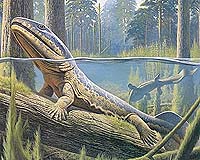
Uppsala, Sweden (SPX) Apr 22, 2009 The fossil record usually shows what adult animals looked like. But the appearance and lifestyle of juvenile animals often differ dramatically from those of the adults. A classic example is provided by frogs and salamanders. New discoveries from Uppsala, Cambridge and Duke Universities, published in Science, show that some of the earliest backboned land animals also underwent such changes of lifestyle as they grew up. Professor Per Ahlberg at the Department of Physiology and Developmental Biology, Uppsala University, together with Jennifer Clack, Cambridge University, and Viviane Callier, Duke University, have studied fossil upper arm bones from the two so-called "four-legged fishes", Ichthtyostega and Acanthostega, from Greenland. These animals, which lived during the Devonian period about 365 million years ago, were among the earliest vertebrates (backboned animals) with fore- and hindlimbs rather than paired fins. They belong to the common stem group of all living amphibians, reptiles, mammals and birds. The researchers have identified several half-grown, as well as fully grown, upper arm bones from Ichthyostega and Acanthostega, allowing them to study how the shape of the bone changed during growth. It turns out that the two animals had different life histories. "The upper arm bone provides a lot of information about the lifestyle of the animal, because its shape gives clues to the pattern of movement and can tell us for example whether the animal lifted the front part of its body clear of the ground," says Per Ahlberg. Ichthyostega, which has robust limbs and only a small tail fin, appears to be the more terrestrial of the two. Its forelimb becomes better adapted to supporting weight as the animal grows up. The pattern of muscle attachments on the upper arm bone changes from a "fish-like" to a "land animal-like" configuration, and the shape of the shoulder joint changes so that it becomes possible for the animal to "lock" its forelimb into a weight-bearing position. Acanthostega has feebler limbs and a large tail fin, and seems to have been more aquatic. In this animal, there are no corresponding changes. "The explanation is probably that both animals laid their eggs in water just like modern amphibians, which meant that the terrestrial Ichthyostega, but not the aquatic Acanthostega, needed to undergo a lifestyle transformation as it grew from larva to adult," says Per Ahlberg. Share This Article With Planet Earth
Related Links Uppsala University Darwin Today At TerraDaily.com
 Feather Color Is More Than Skin Deep
 Barcelona, Spain (SPX) Apr 21, 2009
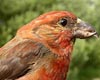
Where do birds get their red feathers from? According to Esther del Val, from the National History Museum in Barcelona, Spain, and her team, the red carotenoids that give the common crossbill (Loxia curvirostra) its red coloration are produced in the liver, not the skin, as previously thought. |
|
|

| The content herein, unless otherwise known to be public domain, are Copyright 1995-2007 - SpaceDaily.AFP and UPI Wire Stories are copyright Agence France-Presse and United Press International. ESA Portal Reports are copyright European Space Agency. All NASA sourced material is public domain. Additional copyrights may apply in whole or part to other bona fide parties. Advertising does not imply endorsement,agreement or approval of any opinions, statements or information provided by SpaceDaily on any Web page published or hosted by SpaceDaily. Privacy Statement |
 del.icio.us
 Digg
Digg Reddit
 YahooMyWeb
 Google
 Facebook