
 |
 |
 |
 |
 |
 |
 |
 |
 |

 |
The Origin Of Supernovae Confirmed
Copenhagen, Denmark (SPX) Mar 24, 2009 Where do supernovae come from? Astronomers have long believed they were exploding stars, but by analysing a series of images, researchers from the Dark Cosmology Centre at the Niels Bohr Institute, University of Copenhagen and from Queens University, Belfast have proven that two dying red supergiant stars produced supernovae. The results are published in the prestigious scientific journal, Science. A star is a large ball of hot gas and in its incredibly hot interior hydrogen atoms combine to form helium, which subsequently forms carbon, other heavier elements and finally iron. When all the atoms in the centre have turned to iron the fuel is depleted and the star dies. When very large and massive stars, that are at least about eight times as massive as our sun, die, they explode as supernovae.
Enormous swollen stars In this phase, the star swells up to an enormous size, approximately 1500 times larger than the sun, and emits as much light as a hundred thousand suns. But there has been doubt over whether red supergiants explode as supernovae. Using images from the Hubble Space Telescope and the Gemini Observatory, Justyn R. Maund, astrophysicist at the Dark Cosmology Centre, Niels Bohr Institute, University of Copenhagen and astrophysicist Stephen J. Smartt, Queens University Belfast, have observed two stars that exploded as supernovae. By analysing archival images of the same section of the sky from long before the explosions, the researchers could see which stars might have gone supernova. But picking out individual stars in the distant universe is difficult, and pinpointing exactly which star it was that exploded is a huge challenge.
Stars became supernovae For one of the supernovae, SN1993J (which exploded in 1993) they found that a red supergiant no longer exists, but that its neighboring star remained. In addition, they found that the red supergiant that was postulated to have caused the supernova SN2003gd has also disappeared. This simple but very time intensive method, establishes that it was these two red supergiant stars that produced the supernovae 2003J and 2003gd, and confirms that red supergiant stars create type II supernovae. Maund and Smartt have found the missing link between red supergiant stars and their supernovae, giving astronomers a greater understanding of how massive stars die. Stellar death is a process crucial for understanding the origin of the chemical elements in the Universe, a precursor necessary ultimately to the formation of planets and life. Share This Article With Planet Earth
Related Links University of Copenhagen Dark Cosmology Centre at the Niels Bohr Institute Stellar Chemistry, The Universe And All Within It
 Hearts Of Galaxies Close In For Cosmic Train Wreck
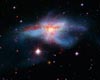 Pasadena CA (SPX) Mar 18, 2009
A new image from NASA's Spitzer Space Telescope offers a rare view of an imminent collision between the cores of two merging galaxies, each powered by a black hole with millions of times the mass of the sun. |
|
|

| The content herein, unless otherwise known to be public domain, are Copyright 1995-2007 - SpaceDaily.AFP and UPI Wire Stories are copyright Agence France-Presse and United Press International. ESA Portal Reports are copyright European Space Agency. All NASA sourced material is public domain. Additional copyrights may apply in whole or part to other bona fide parties. Advertising does not imply endorsement,agreement or approval of any opinions, statements or information provided by SpaceDaily on any Web page published or hosted by SpaceDaily. Privacy Statement |
 del.icio.us
 Digg
Digg Reddit
 YahooMyWeb
 Google
 Facebook