
 |
 |
 |
 |
 |
 |
 |
 |
 |

 |
The Portal To The Universe Opens Its Doors
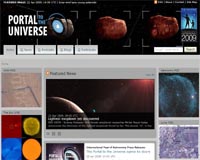
Hertfordshire, UK (SPX) Apr 24, 2009 Keeping up-to-date with cutting-edge astronomy and space science breakthroughs has just become that much easier, thanks to the Portal to the Universe, the latest Cornerstone project of the International Year of Astronomy 2009 (IYA2009). As a high-tech website embracing Web 2.0 technologies, the Portal to the Universe aims to become a one-stop-shop for astronomy news. Released during the European Week of Astronomy and Space Science (JENAM 2009), taking place this week at the University of Hertfordshire, UK, the Portal to the Universe website has been eagerly anticipated by journalists, science communicators, scientists, educators and members of the general public alike. The Portal to the Universe provides a global portal for online astronomy content, serving as an index and aggregator. The site itself features news, blogs, video podcasts, audio podcasts, images, videos and more. Web 2.0 collaborative tools, such as the ranking of different services according to popularity, help the user to sift constructively through the wealth of information available and will promote interactions within the astronomy multimedia community. A range of "widgets" (small applications) have also been developed to tap into all sorts of existing "live data", such as near-live pictures of the Sun, live positions of spacecraft or live observations from telescopes. Project Manager Lars Lindberg Christensen says: "It is clear that even in such a well-defined field as astronomy, there is much more 'information confusion' than you might think. There is a real need in the community for this kind of site, where astronomy content is gathered in one place and is easily accessible. The International Year of Astronomy 2009 seeks to bring the Universe down to Earth, and this Portal is an excellent way of achieving this. This website will provide a single entry point to stars and galaxies". The vision for the Portal is to enable real-time access to content by aggregating (pulling) from providers of dynamic content like blogs, images, news, etc. and distributing (pushing) to users, as well as indexing and archiving, collecting and maintaining a central repository of useful information. Modern technology such as RSS feeds and standardised metadata make it possible to tie all the suppliers of astronomy information together with a single, semi-automatically updating portal. The result is a technologically advanced site that brings together strands of astronomy content from across the worldwide web. Lead developer, Lars Holm Nielsen, says, "It has been a bit of a stretch to ensure that everything goes online just minutes after it has been released. We encourage everyone to participate and to submit RSS feeds for relevant news, images, videos, podcasts etc. to help make the Portal more complete." Lars Lindberg Christensen says: "The release is just the beginning. The project will develop with, and around, the community's needs and lots of new features are planned, including adding resources such as educational materials, addresses for all astronomy stakeholders such as amateur clubs, planetariums and observatories." Share This Article With Planet Earth
Related Links Portal to the Universe IYA2009 Astronomy News from Skynightly.com
 Dramatically Backlit Dust In Giant Galaxy
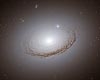 Boston MA (SPX) Apr 13, 2009
A new Hubble image highlights striking swirling dust lanes and glittering globular clusters in oddball galaxy NGC 7049. |
|
|

| The content herein, unless otherwise known to be public domain, are Copyright 1995-2007 - SpaceDaily.AFP and UPI Wire Stories are copyright Agence France-Presse and United Press International. ESA Portal Reports are copyright European Space Agency. All NASA sourced material is public domain. Additional copyrights may apply in whole or part to other bona fide parties. Advertising does not imply endorsement,agreement or approval of any opinions, statements or information provided by SpaceDaily on any Web page published or hosted by SpaceDaily. Privacy Statement |
 del.icio.us
 Digg
Digg Reddit
 YahooMyWeb
 Google
 Facebook