|
 |
 |
 |
 |
 |
 |
 |

| . |  |
. |

|
|
. |

 by Dr. Tony Phillips for NASA Science News Huntsville AL (SPX) Sep 20, 2011
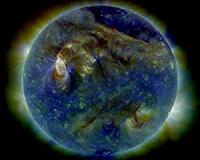
One hundred and fifty two years ago, a man in England named Richard Carrington discovered solar flares. It happened at 11:18 AM on the cloudless morning of Thursday, September 1st, 1859. Just as usual on every sunny day, the 33-year-old solar astronomer was busy in his private observatory, projecting an image of the sun onto a screen and sketching what he saw. On that particular morning, he traced the outlines of an enormous group of sunspots. Suddenly, before his eyes, two brilliant beads of white light appeared over the sunspots; they were so bright he could barely stand to look at the screen. Carrington cried out, but by the time a witness arrived minutes later, the first solar flare anyone had ever seen was fading away. It would not be the last. Since then, astronomers have recorded thousands of strong flares using instruments ranging from the simplest telescopes in backyard observatories to the most complex spectrometers on advanced spacecraft. Possibly no other phenomenon in astronomy has been studied as much. After all that scrutiny, you might suppose that everything about solar flares would be known. Far from it. Researchers recently announced that solar flares have been keeping a secret. "We've just learned that some flares are many times stronger than previously thought," says University of Colorado physicist Tom Woods who led the research team. "Solar flares were already the biggest explosions in the solar system-and this discovery makes them even bigger." NASA's Solar Dynamics Observatory (SDO), launched in February 2010, made the finding: About 1 in 7 flares experience an "aftershock." About ninety minutes after the flare dies down, it springs to life again, producing an extra surge of extreme ultraviolet radiation. "We call it the 'late phase flare,'" says Woods. "The energy in the late phase can exceed the energy of the primary flare by as much as a factor of four." What causes the late phase? Solar flares happen when the magnetic fields of sunspots erupt-a process called "magnetic reconnection." The late phase is thought to result when some of the sunspot's magnetic loops re-form. A diagram prepared by team member Rachel Hock of the University of Colorado shows how it works. The extra energy from the late phase can have a big effect on Earth. Extreme ultraviolet wavelengths are particularly good at heating and ionizing Earth's upper atmosphere. When our planet's atmosphere is heated by extreme UV radiation, it puffs up, accelerating the decay of low-orbiting satellites. Furthermore, the ionizing action of extreme UV can bend radio signals and disrupt the normal operation of GPS. SDO was able to make the discovery because of its unique ability to monitor the sun's extreme UV output in high resolution nearly 24 hours a day, 7 days a week. With that kind of scrutiny, it's tough to keep a secret--even one as old as this. The original research of Woods et al may be found in the Oct. 1, 2011, issue of the Astrophysical Journal. Related Links Solar Dynamics Observatory Solar Science News at SpaceDaily
|
. |
|
| The content herein, unless otherwise known to be public domain, are Copyright 1995-2011 - Space Media Network. AFP and UPI Wire Stories are copyright Agence France-Presse and United Press International. ESA Portal Reports are copyright European Space Agency. All NASA sourced material is public domain. Additional copyrights may apply in whole or part to other bona fide parties. Advertising does not imply endorsement,agreement or approval of any opinions, statements or information provided by Space Media Network on any Web page published or hosted by Space Media Network. Privacy Statement |

 del.icio.us
 Digg
Digg Reddit
 Google