
 |
 |
 |
 |
 |
 |
 |
 |
 |

 |
The Simple Truth about Reusable Launchers Is Not So Simple
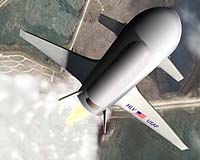
Bethesda MD (SPX) Mar 16, 2009 Launchspace received a lengthy email from Dave of New Mexico concerning a recent piece on reusable launch vehicles (RLVs). We would like to respond with another editorial. Dave objects to our statement: "The simple truth is that we do not know how to make reusables and we cannot make a good business case for them." We considered this statement and concluded that it was not properly qualified. Thus, with our apologies, we would like to correct the record. Yes, we do know how to make reusable launchers. So, why don't we? There are several key factors that have retarded progress in this area. An ideal RLV would be: a single stage vehicle; inexpensive to operate and able to be turned around quickly. Thanks to NASA's failed billion-dollar experience trying to build a scaled down technology demonstrator, the X-33, we can say that single-stage RLVs are beyond the current state of technology. The fundamental reason has to do with the energy needed to achieve orbit and the lack of a propulsion system that can deliver the required vehicle velocity at a high enough efficiency. As a result, using the best propulsion technology available, a single-stage vehicle would have to lift off with a propellant mass fraction approaching 90 percent. In other words, the maximum mass left to reach orbit would be only about 10 percent of the gross liftoff mass. This may not seem to be a show-stopper, but that 10 percent must include everything that is not ascent propellant. This includes all of the structure, propulsion system, propellant tanks and plumbing, avionics, reentry heat shields, residual and maneuvering propellants and payload. Current technology limits us to a minimum mass fraction of about 18 percent. Alas, we are about 80 percent overweight on the amount of mass to orbit. Nevertheless, all may not be lost. What about building a two-stage RLV? Well, Walter Kistler asked the same question, and in the early 1990s he started a company to build and operate a two-stage-to-orbit, fully-reusable vehicle. His company raised over $500 million in private funds and proceeded with the construction of the first flight prototype, the K-1. Walter's design was very conservative and used only existing technology. However, as the vehicle design progressed over a several-year period costs went up and market demand went down. Eventually, his company ran out of money and the financial world tightened up. Sadly, the K-1 was never completed. The lesson from this experience is that reusables are technologically possible, but expensive to build. Without sufficient start up funds and a strong market demand for high launch rates, RLVs are not yet practical. So, the key question is: What would it take to justify the expense of building a reusable launcher system with today's technology? Some say launch prices are too high and, if lowered, the demand would go up. However, several market studies in recent years have concluded that market demand is inelastic, i.e., lower prices will not affect demand unless prices are decreased by factors of 10 or more. Even the most optimistic prognosticators do not agree that RLVs can achieve this, especially in view of current low demand. After all, RLVs make sense only when launch demand is extremely high. Today, the world launches about 60 to 70 times per year. Of these, about 20 launches are dedicated to geostationary injections. Since first generation RLVs will be limited to low orbits, there remain only about 40 launches per year that can be satisfied by a reusable system. This leaves us with the question: Is there a potential market that could justify RLVs in the future? Unfortunately, no one knows. Maybe human tourism flights to Earth orbit will be practical in a decade or two. Maybe there is a future commercial or defense mission that will require hundreds of satellite launches each year. But, no one can justify the investment in RLVs simply based on "maybe." The only logical conclusion is that it seems impractical to pursue RLVs at this time. Share This Article With Planet Earth
Related Links LaunchSpace Encyclopedia Astronautica Nuclear Space Technology at Space-Travel.com
 GOCE Will Map The Earth's Gravity As Never Before
 Paris, France (SPX) Mar 10, 2009
ESA is about to launch the most sophisticated of Earth Observation satellites to investigate the Earth's gravitational field with unprecedented resolution and accuracy. GOCE data will be crucial for obtaining accurate measurements of ocean circulation and sea-level change, both of which are affected by climate change. |
|
|

| The content herein, unless otherwise known to be public domain, are Copyright 1995-2007 - SpaceDaily.AFP and UPI Wire Stories are copyright Agence France-Presse and United Press International. ESA Portal Reports are copyright European Space Agency. All NASA sourced material is public domain. Additional copyrights may apply in whole or part to other bona fide parties. Advertising does not imply endorsement,agreement or approval of any opinions, statements or information provided by SpaceDaily on any Web page published or hosted by SpaceDaily. Privacy Statement |
 del.icio.us
 Digg
Digg Reddit
 YahooMyWeb
 Google
 Facebook