
 |
 |
 |
 |
 |
 |
 |
 |
 |

 |
The Strangulation Of Spiral Galaxies
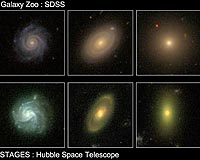
London, UK (SPX) Nov 26, 2008 Astronomers in two UK-led international collaborations have separately uncovered a type of galaxy that represents a missing link in our understanding of galaxy evolution. Galaxy Zoo, which uses volunteers from the general public to classify galaxies and the Space Telescope A901/902 Galaxy Evolution Survey (STAGES) projects have used their vast datasets to disentangle the roles of "nature" and "nurture" in changing galaxies from one variety to another. Both studies have identified a population of unusual red spiral galaxies that are setting out on the road to retirement after a lifetime of forming stars. Crucially, nature and nurture appear to play a role in this transformation: both the mass of a galaxy as well as its local environment are important in determining when and how quickly its star formation is shut down. The scientists' work appears together in a forthcoming edition of Monthly Notices of the Royal Astronomical Society. Astronomers place most normal galaxies into two camps according to their visual appearance: either disk-like systems like our own Milky Way, or round, rugby-ball shaped collections of stars known as ellipticals. In most cases, a galaxy's shape matches its colour: spiral galaxies appear blue because they are still vigorously forming hot young stars. Elliptical galaxies, on the other hand, are mostly old, dead, and red, and tend to cluster together in crowded regions of space. The Galaxy Zoo team examined the connection between the shapes and colours of over one million galaxies using images from the largest ever survey of the local Universe, the Sloan Digital Sky Survey and the help of hundreds of thousands of volunteers from the general public. A key ingredient to their success was reliably classifying the appearance of galaxies by actually looking at them, rather than relying on error-prone computer measurements. Surprisingly, they find that many of the red galaxies in crowded regions are actually spiral galaxies, bucking the trend for red galaxies to be elliptical in shape. These red spiral galaxies may be just the smoking gun astronomers have been looking for. Dr. Steven Bamford, an STFC postdoctoral researcher at the University of Nottingham, led the Galaxy Zoo study. "In order to have spiral arms, they must have been normal, blue, spiral galaxies up until fairly recently. But for some reason their star formation has been stopped, and they have turned red. Whatever caused them to stop forming stars can't have been particularly violent, or it would have destroyed the delicate spiral pattern." The Galaxy Zoo team concludes that a more subtle process must be at work, one that kills off star formation but does not disrupt the overall shape of the galaxy. While Galaxy Zoo looked at the gross properties of millions of galaxies across a large chunk of sky, the STAGES project took a complementary approach by examining in detail just the sort of neighbourhoods where these transformations are expected to occur. Dr. Christian Wolf, an STFC Advanced Research Fellow at the University of Oxford, trained the Hubble Space Telescope on a region of space crowded with galaxies known as the A901/902 supercluster. Like the Galaxy Zoo team, Dr. Wolf also uncovered a surprisingly large population of spiral galaxies in the supercluster that are red in colour. So has the star formation in these red spiral galaxies been completely killed off? The answer is no: despite their colour, the red spirals are actually hiding star formation behind a shroud of dust. Invisible to our (or Hubble's) eye, this star formation is only detectable in the infrared part of the spectrum i.e. radiation emitted from the galaxies at wavelengths longer than visible light. Dr. Wolf remarks, "For the STAGES galaxies, the Spitzer Space Telescope provided us with additional images at infrared wavelengths. With them, we were able to go further and peer through the dust to find the missing piece of the puzzle". Within the supercluster, Dr. Wolf discovered that the red spirals were hiding low levels of hidden star formation, despite their otherwise lifeless appearance in visible light. Putting the observations from both projects together, the picture that emerges is a gentle one: the star formation in blue spiral galaxies is gradually shut off and hidden behind dust, before petering out to form smooth "lenticular" (lens-shaped) red galaxies with no trace of spiral arms. To go further and transform the galaxy into an elliptical would require more violent mechanisms, such as the wholesale collision of galaxies. Location is key: the red spirals are found primarily on the outskirts of crowded regions of space where galaxies cluster together. As a blue galaxy is drawn in by gravity from the rural regions to the suburbs, an interaction with its environment causes a slow-down in star formation. The closer in a galaxy is, the more it is affected. But if environment decides where the process occurs, the mass of the galaxy decides how quickly it takes place. Because both STAGES and Galaxy Zoo looked at such large numbers of galaxies, they were able to further subdivide them according to how much they weighed. Sure enough, both groups find that galaxy mass is also important. Professor Bob Nichol of Portsmouth University, a Galaxy Zoo team member, explains: "Just as a heavyweight fighter can withstand a blow that would bring a normal person to his knees; a big galaxy is more resistant to being messed around by its local environment. Therefore, the red spirals that we see tend to be the larger galaxies - presumably because the smaller ones are transformed more quickly." Chris Lintott, Galaxy Zoo team leader at the University of Oxford, pays tribute to the role of the general public in the Galaxy Zoo research. "These results are possible thanks to a major scientific contribution from our many volunteer armchair astronomers. No group of professionals could have classified this many galaxies alone." Meghan Gray, STFC Advanced Fellow at the University of Nottingham and leader of the STAGES survey, comments on the agreement of the two projects on the role of environment and mass: "Our two projects have approached the problem from very different directions, and it is gratifying to see that we each provide independent pieces of the puzzle pointing to the same conclusion." The next step for both teams is to find out exactly what shuts off the star formation, by looking inside the galaxies themselves. One suspect behind the slow demise of galaxies is a process known as strangulation, in which a galaxy's fuel supply is stripped away as it encounters the crowd. Starved of the raw material needed to form new stars, it will slowly change colour from blue to red as its existing stars age. Share This Article With Planet Earth
Related Links Galaxy Zoo STAGES Stellar Chemistry, The Universe And All Within It
 New Model Promises To Unify View Of Magnetars
 Paris, France (SPX) Nov 24, 2008
A recent model of the emission from ultra-magnetized neutron stars (magnetars) shows great promise in offering a unified view of the high energy emission from these objects. This is reported by Nanda Rea and colleagues in a recent issue of the Astrophysical Journal. The results are based on the systematic analysis of data collected with XMM-Newton and INTEGRAL. |
|
|

| The content herein, unless otherwise known to be public domain, are Copyright 1995-2007 - SpaceDaily.AFP and UPI Wire Stories are copyright Agence France-Presse and United Press International. ESA Portal Reports are copyright European Space Agency. All NASA sourced material is public domain. Additional copyrights may apply in whole or part to other bona fide parties. Advertising does not imply endorsement,agreement or approval of any opinions, statements or information provided by SpaceDaily on any Web page published or hosted by SpaceDaily. Privacy Statement |
 del.icio.us
 Digg
Digg Reddit
 YahooMyWeb
 Google
 Facebook