
 |
 |
 |
 |
 |
 |
 |
 |
 |

 |

Ann Arbor MI (SPX) Dec 22, 2010 New observations by University of Michigan astronomers add weight to the theory that the most massive stars in the universe could form essentially anywhere, including in near isolation; they don't need a large stellar cluster nursery. This is the most detailed observational study to date of massive stars that appear (from the ground) to be alone. The scientists used the Hubble Space Telescope to zoom in on eight of these giants, which range from 20 to 150 times as massive as the Sun. The stars they looked at are in the Small Magellanic Cloud, a dwarf galaxy that's one of the Milky Way's nearest neighbors. Their results, published in the Dec. 20 edition of the Astrophysical Journal, show that five of the stars had no neighbors large enough for Hubble to discern. The remaining three appeared to be in tiny clusters of ten or fewer stars. Doctoral student Joel Lamb and associate professor Sally Oey, both in the Department of Astronomy, explained the significance of their findings. "My dad used to fish in a tiny pond on his grandma's farm," Lamb said. "One day he pulled out a giant largemouth bass. This was the biggest fish he's caught, and he's fished in a lot of big lakes. What we're looking at is analogous to this. We're asking: 'Can a small pond produce a giant fish? Does the size of the lake determine how big the fish is?' The lake in this case would be the cluster of stars. "Our results show that you can, in fact, form big stars in small ponds." The most massive stars direct the evolution of their galaxies. Their winds and radiation shape interstellar gas and promote the birth of new stars. Their violent supernovae explosions create all the heavy elements that are essential for life and the Earth. That's why astronomers want to understand how and where these giant stars form. There is currently a big debate about their origins, Oey said. One theory is that the mass of a star depends on the size of the cluster in which it is born, and only a large star cluster could provide a dense enough source of gas and dust to bring about one of these massive stars. The opposing theory, and the one that this research supports, is that these monstrous stars can and do form more randomly across the universe-including in isolation and in very small clusters. "Our findings don't support the scenario that the maximum mass of a star in a cluster has to correlate with the size of the cluster," Oey said. The researchers acknowledge the possibility that all of the stars they studied might not still be located in the neighborhood they were born in. Two of the stars they examined are known to be runaways that have been kicked out of their birth clusters. But in several cases, the astronomers found wisps of leftover gas nearby, strengthening the possibility that the stars are still in the isolated places where they formed. The title of the paper is "The Sparsest Clusters With O Stars." The research is funded by NASA and the National Science Foundation.
Share This Article With Planet Earth
Related Links University of Michigan Stellar Chemistry, The Universe And All Within It

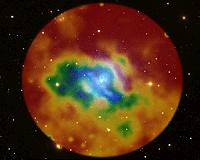 Intergalactic Weather Map
Washington DC (SPX) Dec 10, 2010 This composite image shows an intergalactic "weather map" around the elliptical galaxy NGC 5813, the dominant central galaxy in a galaxy group located about 105 million light years away from Earth. Just like a weather map for a local forecast on Earth, the colored circle depicts variations in temperature across a region. This particular maps presents the range of temperature in a region of ... read more |
|
|
| The content herein, unless otherwise known to be public domain, are Copyright 1995-2010 - SpaceDaily. AFP and UPI Wire Stories are copyright Agence France-Presse and United Press International. ESA Portal Reports are copyright European Space Agency. All NASA sourced material is public domain. Additional copyrights may apply in whole or part to other bona fide parties. Advertising does not imply endorsement,agreement or approval of any opinions, statements or information provided by SpaceDaily on any Web page published or hosted by SpaceDaily. Privacy Statement |


 del.icio.us
 Digg
Digg Reddit
 YahooMyWeb
 Google
 Facebook


