
 |
 |
 |
 |
 |
 |
 |
 |
 |

 |
Thompson Files: U.S. needs more F-22s
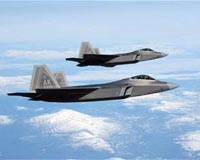
Washington DC (UPI) Apr 14, 2009 U.S. Defense Secretary Robert Gates said the program changes he proposed last week reflected the need to "rebalance" the nation's military posture in light of recent operational experience. That is only half right. They also reflect the fact that 5 percent of the world's population -- the United States -- can no longer afford to sustain nearly 50 percent of global military outlays. Not when our economy's share of global output is declining every year and the U.S. government is spending $5 billion each day that it does not have. You know you're out of money when the only way left to sustain your defense posture is by borrowing money from the biggest military power you might have to fight in the years ahead. So it shouldn't come as a surprise that the only real reason for canceling the Lockheed Martin/Boeing F-22 Raptor fighter advanced by Secretary of the Air Force Michael Donley and Air Force Chief of Staff Gen. Norton Schwartz in an April 13 Washington Post essay was that "buying more F-22s means doing less of something else." The Air Force officials correctly state that defense budgeting has become a "zero-sum game" -- a situation likely to persist as President Barack Obama focuses on domestic initiatives and deficit reduction. But just because the spigot has been turned off at the Pentagon doesn't mean Gates's spending priorities are right. Here are four ways they could be wrong: Defective forecasts. Gates echoes the president in saying we "must enhance our capabilities to fight the wars we are in today and the scenarios we are most likely to face in the years ahead." Unfortunately, U.S. policymakers have been notoriously bad at forecasting future threats. Think of all the surprises of recent history -- the attack on Pearl Harbor in 1941, North Korea's invasion of South Korea in 1950, the Soviet Union starting the Space Age by launching the world's first artificial satellite -- Sputnik I -- in 1957, the Cuban missile crisis in 1962, the Tet Offensive in the Vietnam War in 1968, the collapse of communism in 1991-92 and finally the terrorist attacks of Sept. 11, 2001. The record says the U.S. government seldom knows what's coming next, so basing its defense posture on the belief that it does isn't smart. Diminished deterrence. Gates clearly doubts the need for a new air-superiority fighter since he wants to end F-22 Raptor production at a number far below any analytically derived force objective. He also says the Air Force won't need a new bomber anytime soon and that the Navy can get by with only 10 aircraft carriers -- a level that arrives in 2012, not 2040. However, isn't it likely the reason the American people feel so unthreatened today by the forces of other nations is because the current weapons of the U.S. armed forces deter aggression so effectively? So what happens when our weapons cease to impress? Other nations will respond to U.S. cuts by becoming bolder. Additional people. Gates apparently believes that future threats require a more labor-intensive military posture. So the number of military and civilian personnel in the U.S. Defense Department will increase while investment in technology will decline. The new mix promises to be very costly over the long run since the government's commitment to personnel involves pay and benefits averaging $100,000 per person per year that extend decades into the future. If you think weapons costs are up, check out military healthcare -- up 144 percent in eight years! Why do the U.S. armed forces need all the new personnel if they are getting out of Iraq? Exaggerated danger. Gates thinks the reason the services want so many sophisticated weapons is because they have an exaggerated idea of the conventional threats they will face in the future. Well what about his own assessment of unconventional threats? Does the U.S. government really need to retool its whole defense posture to cope with pirates, narco-terrorists and religious zealots? After eight years of fighting a so-called global war on terror, the accumulated U.S. casualties are about the same as were suffered by both sides in the three-day Battle of Gettysburg in 1863 in the U.S. Civil War -- and that is counting the civilian losses on Sept. 11, 2001. (Loren B. Thompson is chief operating officer of the Lexington Institute, an Arlington, Va.-based think tank that supports democracy and the free market.) Share This Article With Planet Earth
Related Links The Military Industrial Complex at SpaceWar.com Learn about the Superpowers of the 21st Century at SpaceWar.com
 Outside View: USAF needs more F-22s
 Arlington VA (UPI) April 13, 2009
 When Secretary of Defense Robert Gates said April 6 that the U.S. Air Force advised him it wanted 187 Lockheed Martin/Boeing F-22 Raptors, the reaction was shock. |
|
|

| The content herein, unless otherwise known to be public domain, are Copyright 1995-2007 - SpaceDaily.AFP and UPI Wire Stories are copyright Agence France-Presse and United Press International. ESA Portal Reports are copyright European Space Agency. All NASA sourced material is public domain. Additional copyrights may apply in whole or part to other bona fide parties. Advertising does not imply endorsement,agreement or approval of any opinions, statements or information provided by SpaceDaily on any Web page published or hosted by SpaceDaily. Privacy Statement |
 del.icio.us
 Digg
Digg Reddit
 YahooMyWeb
 Google
 Facebook