
 |
 |
 |
 |
 |
 |
 |
 |
 |

 |
Tiny Solar Cells Built To Power Microscopic Machines
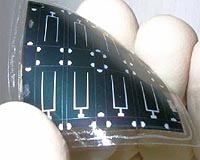
College Park MD (SPX) Nov 11, 2008 Some of the tiniest solar cells ever built have been successfully tested as a power source for even tinier microscopic machines. An article in the inaugural issue of the Journal of Renewable and Sustainable Energy (JRSE), published by the American Institute of Physics (AIP), describes an inch-long array of 20 of these cells -- each one about a quarter the size of a lowercase "o" in a standard 12-point font. The cells were made of an organic polymer and were joined together in an experiment aimed at proving their ability to power tiny devices that can be used to detect chemical leaks and for other applications, says Xiaomei Jiang, who led the research at the University of South Florida. Traditional solar cells, such as the commercial type installed on rooftops, use a brittle backing made of silicon, the same sort of material upon which computer chips are built. By contrast, organic solar cells rely upon a polymer that has the same electrical properties of silicon wafers but can be dissolved and printed onto flexible material. "I think these materials have a lot more potential than traditional silicon," says Jiang. "They could be sprayed on any surface that is exposed to sunlight -- a uniform, a car, a house." Jiang and her colleagues fabricated their array of 20 tiny solar cells as a power source for running a microscopic sensor for detecting dangerous chemicals and toxins. The detector, known as a microeletromechanical system (MEMS) device, is built with carbon nanotubes and has already been tested using ordinary DC power supplied by batteries. When fully powered and hooked into a circuit, the carbon nanotubes can sensitively detect particular chemicals by measuring the electrical changes that occur when chemicals enter the tubes. The type of chemical can be distinguished by the exact change in the electrical signal. The device needs a 15-volt power source to work, so far and Jiang's solar cell array can provide about half of that -- up to 7.8 volts in their laboratory tests. The next step, she says, is to optimize the device to increase the voltage and then combine the miniature solar array to the carbon nanotube chemical sensors. Jiang estimates they will be able to demonstrate this level of power with their next generation solar array by the end of the year. Share This Article With Planet Earth
Related Links American Institute of Physics Journal of Renewable and Sustainable Energy (JRSE) All About Solar Energy at SolarDaily.com
 LA's First Solar-Powered, All-Green Urban Community Premieres In Hollywood
 Hollywood CA (SPX) Nov 11, 2008
Utility costs may be rising, but utility rates will remain at an all-time low at one eco-friendly Southern California community. The Gatsby Hollywood has announced it will be Metro L.A.'s first all solar-powered, all-green urban community. |
|
|

| The content herein, unless otherwise known to be public domain, are Copyright 1995-2007 - SpaceDaily.AFP and UPI Wire Stories are copyright Agence France-Presse and United Press International. ESA Portal Reports are copyright European Space Agency. All NASA sourced material is public domain. Additional copyrights may apply in whole or part to other bona fide parties. Advertising does not imply endorsement,agreement or approval of any opinions, statements or information provided by SpaceDaily on any Web page published or hosted by SpaceDaily. Privacy Statement |
 del.icio.us
 Digg
Digg Reddit
 YahooMyWeb
 Google
 Facebook