. Energy News .


SATURN DAILY
Titan's Methane: Going, Going, Soon to Be Gone?
by Staff Writers
Pasadena CA (JPL) Apr 17, 2013


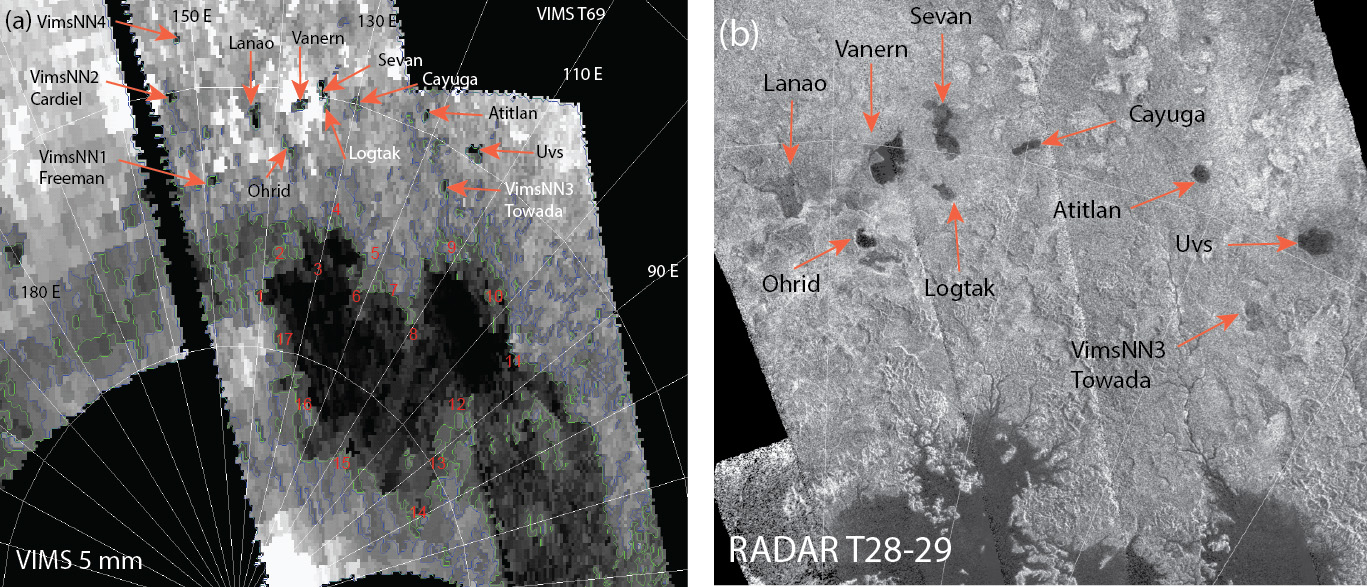
These images from NASA's Cassini spacecraft show one of the large seas and a bounty of smaller lakes on Saturn's moon Titan. Scientists saw these small lakes in data obtained by both Cassini's visual and infrared mapping spectrometer (left) and radar instrument (right). Image credit: NASA/JPL-Caltech/University of Arizona. For a larger version of this image please go here.

By tracking a part of the surface of Saturn's moon Titan over several years, NASA's Cassini mission has found a remarkable longevity to the hydrocarbon lakes on the moon's surface.

A team led by Christophe Sotin of NASA's Jet Propulsion Laboratory in Pasadena, Calif., fed these results into a model that suggests the supply of the hydrocarbon methane at Titan could be coming to an end soon (on geological timescales). The study of the lakes also led scientists to spot a few new ones in images from Cassini's visual and infrared mapping spectrometer data in June 2010.

Titan is the only other place in the solar system besides Earth that has stable liquid on its surface. Scientists think methane is at the heart of a cycle at Titan that is somewhat similar to the role of water in Earth's hydrological cycle - causing rain, carving channels and evaporating from lakes.

However, the fact that the lakes seem remarkably consistent in size and shape over several years of data from Cassini's visual and infrared mapping spectrometer suggests that the lakes evaporate very slowly. Methane tends to evaporate quickly, so scientists think the lakes must be dominated by methane's sister hydrocarbon ethane, which evaporates more slowly.

The lakes are also not getting filled quickly, and scientists haven't seen more than the occasional outburst of hydrocarbon rain at the moon over the mission's eight-plus years in the Saturn system.

This indicates that on Titan, the methane that is constantly being lost by breaking down to form ethane and other heavier molecules is not being replaced by fresh methane from the interior.

The team suggests that the current load of methane at Titan may have come from some kind of gigantic outburst from the interior eons ago possibly after a huge impact. They think Titan's methane could run out in tens of millions of years.

.


Related Links
Saturn at JPL
Explore The Ring World of Saturn and her moons
Jupiter and its Moons
The million outer planets of a star called Sol
News Flash at Mercury


Comment on this article via your Facebook, Yahoo, AOL, Hotmail login.

Share this article via these popular social media networks
del.icio.usdel.icio.us DiggDigg RedditReddit GoogleGoogle


Memory Foam Mattress Review

Newsletters :: SpaceDaily Express :: SpaceWar Express :: TerraDaily Express :: Energy Daily
XML Feeds :: Space News :: Earth News :: War News :: Solar Energy News

Get Our Free Newsletters
Space - Defense - Environment - Energy - Solar - Nuclear

...


SATURN DAILY
Ice Cloud Heralds Fall at Titan's South Pole
Greenbelt MD (SPX) Apr 15, 2013
An ice cloud taking shape over Titan's south pole is the latest sign that the change of seasons is setting off a cascade of radical changes in the atmosphere of Saturn's largest moon. Made from an unknown ice, this type of cloud has long hung over Titan's north pole, where it is now fading, according to observations made by the Composite Infrared Spectrometer (CIRS) on NASA's Cassini spacecraft. ... read more


SATURN DAILY
Eye Exam for a Satellite

DMCii increases downlink capacity with Svalbard ground station facilities

A look at the world explains 90 percent of changes in vegetation

Belarus, Russia to Create New Satellite Grouping

SATURN DAILY
Sat-nav warns London lorry drivers of cyclists

Altus Introduces New GNSS Survey Receiver With 10-cm Terrastar-D

Lockheed Martin GPS Satellites To Help Test New L2C Signal Civil Navigation Capability to Improve GPS Navigation

Smithsonian dedicates new exhibition to navigation

SATURN DAILY
Brazil urged to stop invading indigenous lands

Indonesia moves towards approving deforestation plan

New research challenges assumptions about effects of global warming on mountain tree line

Brazil's indigenous protest to defend ancestral lands

SATURN DAILY
Sweden proposes extending tax breaks for biofuels, green cars

A key to mass extinctions could boost food, biofuel production

NREL Survey Shows Dramatic Improvement in B100 Biodiesel Quality

Surprising findings on hydrogen production in green algae

SATURN DAILY
New solar-cell coating could boost efficiency

PV Inverter Revenue Expands to $7 Billion in 2012

Physicians Unite with Solar Energy Companies to Form New Group

Renewable energy thrives in Japan

SATURN DAILY
U.S. leads in wind installations

Providing Capital and Technology, GE is Farming the Wind in America's Heartland with Enel Green Power

Wind skeptic British minister replaced

Using fluctuating wind power

SATURN DAILY
Outside View: Coal exports save lives

China mine blast kills 28: state media

Six dead, 11 missing, in new blast at China mine

China mine accident kills 21: state media

SATURN DAILY
Experts probe human-to-human spread of China bird flu

China media praise reformer whose death sparked Tiananmen

China media praise reformer whose death sparked Tiananmen

Tibetans who commit suicide 'not crazy': Dalai Lama


The content herein, unless otherwise known to be public domain, are Copyright 1995-2012 - Space Media Network. AFP, UPI and IANS news wire stories are copyright Agence France-Presse, United Press International and Indo-Asia News Service. ESA Portal Reports are copyright European Space Agency. All NASA sourced material is public domain. Additional copyrights may apply in whole or part to other bona fide parties. Advertising does not imply endorsement,agreement or approval of any opinions, statements or information provided by Space Media Network on any Web page published or hosted by Space Media Network. Privacy Statement