
 |
 |
 |
 |
 |
 |
 |
 |
 |

 |
Tom Cruise Smile Comes With A Sunburn Price
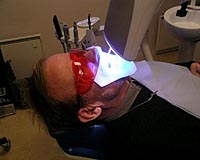
London, UK (SPX) Feb 06, 2009 UV light-enhanced tooth bleaching is not only a con, but is dangerous to your eyes and skin, says a Royal Society of Chemistry journal. The light treatment gives absolutely no benefit over bleaching without UV, and damages skin and eyes up to four times as much as sunbathing, reports a study in Photochemical and Photobiological Sciences. Those looking to match Tom Cruise's glittering pearly-whites would be better off ignoring claims of better bleaching with UV light treatment. The treatment is at least as damaging to skin and eyes as sunbathing in Hyde Park for a midsummer's afternoon - one lamp actually gave four times that level of radiation exposure. And as with sunbathing, fair-skinned or light-sensitive people are at even greater risk, said lead author Ellen Bruzell of the Nordic Institute of Dental Materials. Bruzell also found that bleaching damaged teeth. She saw more exposed grooves on the enamel surface of bleached teeth than on unbleached teeth. These grooves make the teeth more vulnerable to mechanical stress. Tooth bleaching is one of the most popular cosmetic dental treatments available. It uses a bleaching agent - usually hydrogen peroxide - to remove stains such as those from red wine, tea and coffee, and smoking. UV light is claimed to further activate the oxidation process, improving bleaching efficiency. The authors of this Photochemical and Photobiological Sciences article say there is very little substantive evidence to support this claim, and their new study finds no benefit to using UV light. Share This Article With Planet Earth
Related Links Royal Society of Chemistry All About Human Beings and How We Got To Be Here
 Learning Science Facts Doesn't Boost Science Reasoning
 Columbus OH (SPX) Feb 05, 2009
A study of college freshmen in the United States and in China found that Chinese students know more science facts than their American counterparts - but both groups are nearly identical when it comes to their ability to do scientific reasoning. |
|
|

| The content herein, unless otherwise known to be public domain, are Copyright 1995-2007 - SpaceDaily.AFP and UPI Wire Stories are copyright Agence France-Presse and United Press International. ESA Portal Reports are copyright European Space Agency. All NASA sourced material is public domain. Additional copyrights may apply in whole or part to other bona fide parties. Advertising does not imply endorsement,agreement or approval of any opinions, statements or information provided by SpaceDaily on any Web page published or hosted by SpaceDaily. Privacy Statement |
 del.icio.us
 Digg
Digg Reddit
 YahooMyWeb
 Google
 Facebook