
 |
 |
 |
 |
 |
 |
 |
 |
 |

 |

Maungu, Kenya (AFP) March 8, 2011 Mwakitau Kaleghe used to scratch out a living from burning charcoal, culled from trees whose felling helped turn a rich tropical woodland in southern Kenya into a desolate mosaic. Today, though, sees Kaleghe, 65, enlisted in an environmental war, as a captor of carbon rather than an emitter of it and as a custodian of Rukinga forest rather than an agent in its destruction. Kaleghe nurtures tree seedlings that he then sells to a UN-backed project carbon-credit project. Trees suck up carbon dioxide (CO2), the principal greenhouse gas that traps solar heat. Under the Reducing Emissions from Deforestation and Degradation (REDD) initiative, CO2 emitters in industrialised countries can "offset" their pollution by conserving tropical forests or replanting cleared or damaged areas. Wildlife Works, a US conservation group, says 30,000 hectares (75,000 acres) of forest are under its wing in the Rukinga REDD scheme. It has sealed a deal with South Africa's Nedbank group, keen to establish "carbon-neutral" credentials, for the sale of 200,000 tonnes of CO2 for around one million dollars. Some of the proceeds are earmarked for local projects to give the community alternative sources of income other than clearing land for subsistence farming and charcoal burning. "If they buy the seedlings at a good price, I think we can make ends meet," said Kaleghe. "I used to make good money from selling charcoal but I won't start making charcoal again because that is destroying the forest." Apart from tree planting, the project also runs a garment factory that sells clothes for export and plans to pipe water to the community. "With the projects lined up, the community is very happy. At the moment we are living in hope," said James Mwakina Mboga, the local councillor, who sounds however a note of caution. "If the promises don't materialise, then we will go back to our old ways," he said, referring to the rampant charcoal burning and subsistence farming that denuded and exhausted the soil. Carbon credit projects entail complex calculations about vegetation cover, soil content and duration to estimate the amount of CO2 that is lost through deforestation and land degradation. Projects also have to be vetted to ensure they are not scams by loggers. The Rukinga carbon credits are a milestone, though. They are the first to be issued under a new benchmark, called the Voluntary Carbon Standard (VCS), which seeks to uphold criteria of sustainability, ecological soundness and help for the local community. Eventually, 30 million tonnes of CO2 will be saved over 20 years, Wildlife Works hopes. Reforestation should also be a boon for biodiversity. The forest straddles the east and west sides of Tsavo National Park, Kenya's largest, and its renewal eventually will provide a corridor for migrating wildlife. The strategy also involves the community, which forms committees to choose the most important projects they want funded. In this arid region, water tops the list, then roads, education or health. Rob Dodson, who heads Rukinga Wildlife Works, said he saw widespread support from local people who had been aware, bit by bit, of the degradation of the forest and its impact on their lives. "It is such a desperate situation... the people can see what is happening," he said. "They can see the rainfall decreasing year after year. They know that subsistence farming isn't working. They've been so receptive, they're willing to try anything that could be an alternative."
Share This Article With Planet Earth
Related Links Forestry News - Global and Local News, Science and Application

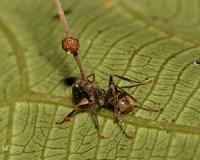 Four New Species Of Zombie Ant Fungi Discovered
Los Angeles CA (SPX) Mar 04, 2011 Four new Brazilian species in the genus Ophiocordyceps have been published in the online journal PLoS ONE. The fungi, named by Dr. Harry Evans and Dr. David Hughes, belong to a group of "zombifying" fungi that infect ants and then manipulate their behavior, eventually killing the ants after securing a prime location for spore dispersal. These results appear in a paper by Evans et al. entit ... read more |
|
|
| The content herein, unless otherwise known to be public domain, are Copyright 1995-2010 - SpaceDaily. AFP and UPI Wire Stories are copyright Agence France-Presse and United Press International. ESA Portal Reports are copyright European Space Agency. All NASA sourced material is public domain. Additional copyrights may apply in whole or part to other bona fide parties. Advertising does not imply endorsement,agreement or approval of any opinions, statements or information provided by SpaceDaily on any Web page published or hosted by SpaceDaily. Privacy Statement |


 del.icio.us
 Digg
Digg Reddit
 YahooMyWeb
 Google
 Facebook


