
 |
 |
 |
 |
 |
 |
 |
 |
 |

 |
UAB Space Freezers Deemed A Success
Birmingham AL (SPX) Mar 18, 2009 The newest generation of compact research freezers is performing well in space and have already boosted the scientific capacity of the International Space Station (ISS), said engineers at the University of Alabama at Birmingham (UAB). A UAB-designed cryogenic freezer called GLACIER, short for General Laboratory Active Cryogenic ISS Experiment Refrigerator, made its NASA debut in late 2008 aboard a shuttle flight to the station. This month's flight of space shuttle Discovery marks another milestone for GLACIER as the first freezer is re-packed on the shuttle for return to Earth. It is filled with frozen blood samples, cell cultures and other experiments. From a satellite-linked control center in Birmingham, engineers at UAB's Center for Biophysical Sciences and Engineering recently sent the first 'start-up' signals to the ISS to begin cooling down GLACIER. It took more than six hours to reach the target temperature of minus 95 degrees Celsius, said UAB project coordinator Josh Dunn. Just as the first GLACIER returns with its science cargo, a second freezer will be installed in its place on the ISS and prepped for more research samples. The freezers are part of a National Aeronautics and Space Administration contract awarded to the UAB biophysical center in 2005. Share This Article With Planet Earth
Related Links University of Alabama at Birmingham Station at NASA Station and More at Roscosmos S.P. Korolev RSC Energia Watch NASA TV via Space.TV Space Station News at Space-Travel.Com
 Expedition 18 Ready To Take A Walk
 Houston TX (SPX) Mar 10, 2009
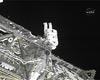
Aboard the orbiting International Space Station Monday, the Expedition 18 crew had a bit of down time. After Sunday's suited fit check of their Orlan spacesuits, Commander Mike Fincke and Flight Engineer Yury Lonchakov relaxed Monday in advance of their spacewalk slated to begin at 12:20 p.m. EDT Tuesday. Lonchakov, the lead spacewalker or EV 1, will wear the Orlan suit with the blue stripes. |
|
|

| The content herein, unless otherwise known to be public domain, are Copyright 1995-2007 - SpaceDaily.AFP and UPI Wire Stories are copyright Agence France-Presse and United Press International. ESA Portal Reports are copyright European Space Agency. All NASA sourced material is public domain. Additional copyrights may apply in whole or part to other bona fide parties. Advertising does not imply endorsement,agreement or approval of any opinions, statements or information provided by SpaceDaily on any Web page published or hosted by SpaceDaily. Privacy Statement |
 del.icio.us
 Digg
Digg Reddit
 YahooMyWeb
 Google
 Facebook