
 |
 |
 |
 |
 |
 |
 |
 |
 |

 |
U.S., Chinese scientists build nanorobot
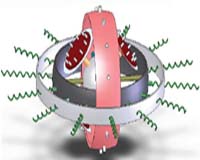
New York (UPI) Feb 16, 2009 U.S. and Chinese scientists say they've created a two-armed nanorobot that can manipulate molecules within a device built from DNA. Researchers at New York University and China's Nanjing University said the programmable unit allows researchers to capture and maneuver patterns on a scale that is unprecedented. New York University Professor Nadrian Seeman, one of the study's co-authors, said the two-armed nanorobotic device enables the creation of new DNA structures, thereby potentially serving as a factory for assembling the building blocks of new materials. With that capability, it has the potential to develop new synthetic fibers, advance the encryption of information and improve DNA-scaffolded computer assembly, he said. In the two-armed nanorobotic device, the arms face each other, ready to capture molecules that make up a DNA sequence. Using set strands that bind to its molecules, the arms are then able to change the structure of the device. This changes the sticky ends available to capture a new pattern component. The researchers said their device performs with 100 percent accuracy, as confirmed by atomic force microscopy that permits features a few billionths of a meter to be visualized. The research that included Nanjing Professor Shou-Jun Xiao and graduate students Hongzhou Gu and Jie Chao, is reported in the journal Nature Nanotechnology. Share This Article With Planet Earth
Related Links All about the robots on Earth and beyond!
 NASA And Caltech Test Steep-Terrain Rover
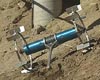 Pasadena CA (SPX) Feb 06, 2009
Engineers from NASA's Jet Propulsion Laboratory and students at the California Institute of Technology have designed and tested a versatile, low-mass robot that can rappel off cliffs, travel nimbly over steep and rocky terrain, and explore deep craters. |
|
|

| The content herein, unless otherwise known to be public domain, are Copyright 1995-2007 - SpaceDaily.AFP and UPI Wire Stories are copyright Agence France-Presse and United Press International. ESA Portal Reports are copyright European Space Agency. All NASA sourced material is public domain. Additional copyrights may apply in whole or part to other bona fide parties. Advertising does not imply endorsement,agreement or approval of any opinions, statements or information provided by SpaceDaily on any Web page published or hosted by SpaceDaily. Privacy Statement |
 del.icio.us
 Digg
Digg Reddit
 YahooMyWeb
 Google
 Facebook