
 |
 |
 |
 |
 |
 |
 |
 |
 |

 |
US change on Iran could be 'barrier' breaker: analysts
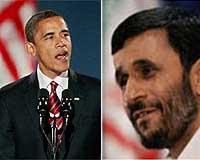
Washington (AFP) April 14, 2009 A reported sea change in US policy towards Iran could prompt the Islamic republic to return to talks over its nuclear program and lead to a breakthrough in decades of antagonizing relations with Washington, analysts said Tuesday. But conservatives long wary of Tehran's nuclear ambitions said any scrapping of a US demand to stop enriching uranium in the early stage of negotiations would hand Iran a crucial victory in what they believe is Iran's pursuit of an atomic bomb. The apparent plan by President Barack Obama's administration to drop the suspension demand was reported Tuesday by The New York Times, which cited unnamed officials saying US and European allies proposed to ease the longstanding policy as a way to get Tehran to open its nuclear program to inspection. President George W. Bush had insisted that Iran mothball its enrichment program before talks begin, amid fears the activities may be part of a nuclear weapons drive. The new policy, if confirmed, marks a "concession to reality" by the Obama administration, analyst Karim Sadjadpour told AFP. "This was a necessary step to commence the negotiations, because it's been clear for quite some time that Iran has been willing to endure sanctions and hardship rather than suspend uranium enrichment," said Sadjadpour, an associate at the Carnegie Endowment for International Peace. "It's a starting point," added Suzanne Maloney of the Saban Center for Middle East Policy at the Brookings Institution, a Washington-based think tank. "It's very difficult to draw the Iranians to the table under any circumstances. But this would be the best opportunity in post-revolutionary history to actually engage the Iranians in serious comprehensive talks." Washington broke off ties with Tehran in 1980 shortly after Iran's Islamic revolution, and relations have remained ruptured ever since. Tehran agreed to inspections by the International Atomic Energy Agency, the UN nuclear watchdog, in 2003 but pulled out of the arrangement in 2006. Enriching uranium so that it can be used for nuclear power -- or building a weapon of mass destruction -- lies at the heart of the controversy surrounding Iran's nuclear program. The so-called P5-plus-1 -- the permanent five members of the UN Security Council, plus Germany -- have long offered Iran trade, financial and other incentives in return for halting its uranium enrichment program. But Tehran has refused. "This has been the sticking point for Iran in any continuing negotiations," said Shaul Bakhash, a professor of Middle East history at George Mason University, outside the US capital. "If it takes place, (dropping the suspension demand) will be a significant change over the Bush administration's position," he said. "We obviously have to wait for the Iranian reaction," he said. "But if that suspension requirement is lifted ... at last that barrier for engagement will have been removed." For the most part US officials have not met directly with their Iranian counterparts for nearly three decades, although Obama said during last year's presidential campaign that he was willing to meet with Iran's hardline President Mahmoud Ahmadinejad without preconditions. Also on Tuesday Ahmadinejad said Tehran is building new rockets to carry heavier payloads and proceeding with the manufacture of nuclear fuel. Last week, he inaugurated Iran's first nuclear fuel plant in the central province of Isfahan, indicating that the country had mastered the complete nuclear fuel cycle. Some analysts believe conceding to Tehran's uranium enrichment is courting a crisis. "It's a weakening of the US position, and there's a real danger that Iran could exploit it," argued James Phillips of the Heritage Foundation. "Engaging without conditions allows them to run out the clock," he added. "Eventually Iran tests a nuclear weapon, and then what is there to negotiate about?" Philipps said Europe and Washington should tighten sanctions in order to maximize pressure on Iran. But the Times said European and Obama administration officials concluded that Tehran would refuse to shut down its enrichment facilities. "We have all agreed that is simply not going to work -- experience tells us the Iranians are not going to buy it," the Times quoted a European diplomat as saying. The White House meanwhile described the Times report as "not accurate," but the State Department declined to dismiss it outright. "The P-5-plus-1 stated last week that we... were willing to resolve our shared concerns with Iran's nuclear program through direct diplomacy. And nothing has changed," State Department spokesman Robert Wood told reporters. "Suspension is still our goal." Share This Article With Planet Earth
Related Links Learn about nuclear weapons doctrine and defense at SpaceWar.com Learn about missile defense at SpaceWar.com All about missiles at SpaceWar.com Learn about the Superpowers of the 21st Century at SpaceWar.com
 US welcomes Iran's stated readiness for dialogue
 Washington (AFP) April 13, 2009
The United States on Monday hailed Iran's stated readiness to talk with Washington and its five partners in negotiations aimed at halting Tehran's nuclear ambitions. |
|
|

| The content herein, unless otherwise known to be public domain, are Copyright 1995-2007 - SpaceDaily.AFP and UPI Wire Stories are copyright Agence France-Presse and United Press International. ESA Portal Reports are copyright European Space Agency. All NASA sourced material is public domain. Additional copyrights may apply in whole or part to other bona fide parties. Advertising does not imply endorsement,agreement or approval of any opinions, statements or information provided by SpaceDaily on any Web page published or hosted by SpaceDaily. Privacy Statement |
 del.icio.us
 Digg
Digg Reddit
 YahooMyWeb
 Google
 Facebook