|
Venice plans to raise its sinking buildings as sea levels rise
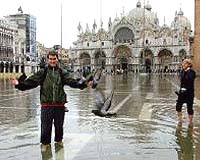
Venice, Italy (AFP) March 21, 2008 Venice is planning to raise its buildings to protect them against rising sea levels, daily Italian newspaper La Stampa said on Friday. Local officials and engineers are planning to lift buildings under operation "Rialto" by up to one metre (3.3 feet) using piston-supported-poles to be placed at the bottom of each structure. This will take around a month per building if each structure is raised by eight centimetres (3.14 inches) a day. The mayor of Venice, Massimo Cacciari, said: "We're pursuing this proposal with great interest." This project is an alternative to a previous one nicknamed "Moses", which began in 2003 and is due to end in 2012. "Moses" is expected to cost around four billion euros (six billion dollars) under huge plans to build 78 mobile barriers at a stretch of two kilometres (1.2 miles) by the lagoon's entrance. Those in favour of "Rialto" claim the project, with an estimated cost of 2,500 euros (3,800 dollars) per square metre, will allow Venice, which sank by 23 centimetres (nine inches) in the last century, to regain its original look and to preserve its buildings. Venice was flooded 50 times between 1993 and 2002. The worst recorded high waters were in November 1966 when the city was submerged by 1.94 metres (6.3 feet) of water, as the rest of Italy was also battling heavy floods. Community Email This Article Comment On This Article Related Links Water News - Science, Technology and Politics
 Extinct seal tells of once-teeming Caribbean reefs
 Paris (AFP) March 19, 2008
Several hundred years ago, the coral reefs of the Caribbean had up to six times more fish than they have today, according to a study published Wednesday. |
|
|
| The content herein, unless otherwise known to be public domain, are Copyright Space.TV Corporation. AFP and UPI Wire Stories are copyright Agence France-Presse and United Press International. ESA Portal Reports are copyright European Space Agency. All NASA sourced material is public domain. Additional copyrights may apply in whole or part to other bona fide parties. Advertising does not imply endorsement, agreement or approval of any opinions, statements or information provided by Space.TV Corp on any Web page published or hosted by Space.TV Corp. Privacy Statement |