
 |
 |
 |
 |
 |
 |
 |
 |
 |

 |
When The Military Industrial Complex Runs Out Of Cash Part Two
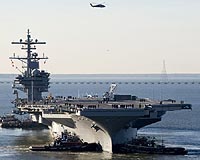
Washington (UPI) Mar 3, 2009 The United States is committing significant new military forces to the "good war" in Afghanistan. Still, while here in Washington we are contemplating a budget deficit that is approaching banana republic levels because of stimulus spending and assorted bailouts, how are we planning to pay for these new military deployments? On Jan. 10, 2009, there was the solemn commissioning of the George Herbert Walker Bush, or CVN 77, the last nuclear-powered super-aircraft carrier of the Nimitz class. It was named after "Bush 41," the father of President George W. Bush. The outgoing president, "Bush 43," his son, presided over the ceremony honoring his father just a few days before leaving office. Therefore the immensely expensive nuclear-powered supercarrier George Herbert Walker Bush starts sailing the oceans in the year of the Great Crisis. This 78,000-ton ship, built by Northrop Grumman, with all its aircraft and helicopters and its battle group complement of cruisers, frigates and other supporting vessels, is the ultimate expression of U.S. naval technology and sea power. Indeed, as Secretary of the Navy Donald Winter said during the ceremony: "The impact of a new carrier is global. For no other ship represents to the world the power of the United States the way this does." But nuclear-powered supercarriers and their supporting battle groups do not come cheap. So, add another few billion dollars to the defense procurement bill stretched over a number of construction years. Nor are they cheap to operate. Therefore, add another several hundred millions of dollars for the annual operating cost of this floating island and the other vessels accompanying it, with thousands of airmen and sailors on them. The front-line combat air superiority fighters of the U.S. Air Force are now almost as expensive per unit as the nation's warships. Answering a reporter's question on Feb. 13 regarding the chances of buying large numbers of the very expensive Lockheed Martin/Boeing F-22 Raptor, the U.S. Air Force's next-generation fighter jet, Pentagon spokesman Geoff Morrell gave us a hint that the U.S. Department of Defense is aware that money is becoming scarce and tough choices are ahead so that U.S. military leaders will no longer be able to get all the weapon systems that they want. "Fundamentally, the Secretary (of Defense Robert Gates) is looking at the things I laid out for you, I mean, the notion that we need to make hard choices in this economic climate, we need to ... look for cost efficiencies, and we need to be more joint in how we acquire ... ," Morrell said. His comments should serve as a highly significant indicator that Gates recognizes major changes in U.S. procurement planning and acquisition processes are coming.
(Paolo Liebl von Schirach is the editor of SchirachReport.com, a regular contributor to Swiss radio and an international economic development expert.)
(United Press International's "Outside View" commentaries are written by outside contributors who specialize in a variety of important issues. The views expressed do not necessarily reflect those of United Press International. In the interests of creating an open forum, original submissions are invited.)
Related Links The Military Industrial Complex at SpaceWar.com Learn about the Superpowers of the 21st Century at SpaceWar.com
 Eurocopter wins first order from Japan's military
 Tokyo (AFP) March 2, 2009
Eurocopter said Monday that it had won its first order from Japan's military for two training helicopters, a deal that the European manufacturer hopes will increase to 15 aircraft. |
|
|

| The content herein, unless otherwise known to be public domain, are Copyright 1995-2007 - SpaceDaily.AFP and UPI Wire Stories are copyright Agence France-Presse and United Press International. ESA Portal Reports are copyright European Space Agency. All NASA sourced material is public domain. Additional copyrights may apply in whole or part to other bona fide parties. Advertising does not imply endorsement,agreement or approval of any opinions, statements or information provided by SpaceDaily on any Web page published or hosted by SpaceDaily. Privacy Statement |
 del.icio.us
 Digg
Digg Reddit
 YahooMyWeb
 Google
 Facebook