

 |

Newark NJ (SPX) Aug 30, 2010 Why sunspots are a strong source of radio emissions and what information those emissions carry will be the focus of an invited talk by NJIT Research Professor Jeongwoo Lee tomorrow at the International Astronomical Union Symposium on the Physics of Sun and Star Spots in Ventura, CA. The event numbers among the top gatherings in the U.S. for people studying sunspots and related phenomena. Lee will highlight Owens Valley Solar Array (OVSA), one of the two unique frequency-agile radio telescopes in the world. NJIT has managed and operated the facility since 1997. Research opportunities there coupled with Lee's earlier article-- "Radio Emissions from Solar Active Regions" Space Science Reviews, Vol. 133, 73-102--will be the foundation for the talk. Owens Valley Solar Array features an unusually large number of frequencies (up to 86) in the range of 1-18 GHz, which can exploit the unique sensitivity of the gyroresonant spectrum to coronal magnetic fields. The imaging spectroscopy (a technique for constructing spectrum in every spatial point of interest) of sunspots implemented with the OVSA is one of the best examples for unambiguous observational determination of the coronal magnetic field and temperature. Why are sunspots such strong sources of radio emission? "The solar corona is of tenuous plasma which is generally too faint to be detected by ground-based observations," he said. "Sunspots, though, appear to be very bright at centimeter wavelengths because hot electrons (which are millions of degrees) gyrate in the coronal magnetic field. As they gyrate, they produce an efficient radiation called gyroresonant emission. This emission can serve as an excellent indicator of the magnetic field and temperature in the coronae above sunspots. The ability to measure these quantities without the complications arising in other solar radiations is a particular advantage for studying sunspot radio emissions." The lecture will also look at the contributions of the premier radio array for astronomical observations operated by the National Radio Astronomy Observatory known as the "Very Large Array" (VLA). This facility is capable of high-quality imaging at a few wavelengths in the centimeter range. VLA solar images have been used to perform many studies of sunspot physics. Highlights of the VLA's scientific achievements include findings of inhomogeneous structures of plasma and magnetic fields, and the presence of electric currents and waves in the sunspot coronae. The Nobeyama Radioheliograph (NoRH), a solar-dedicated radio heliograph in Japan, will also be covered. This facility has made an important contribution to understanding the evolving nature of sunspot emissions. The radio synoptic map and butterfly diagram constructed with the eighteen-year measurement of the solar full disk provides an important clue to understanding the nature of the solar cycle. The talk concludes with a plea to support a new generation of radio telescopes, a dream that Lee and his NJIT colleagues, as well as NRAO, is already pursuing. "Such an array should feature as many frequencies as Owens Valley Solar Array offers and as high-resolution imaging as the VLA performs," Lee said. "It will advance the study of three-dimensional structures of temperature and magnetic fields above sunspots. And, it will allow scientists to continue monitoring time-dependent solar radio activity, such as rapid transient heating, sunspot oscillations, and solar cycle dependence of coronal temperature."
Share This Article With Planet Earth
Related Links New Jersey Institute of Technology Solar Science News at SpaceDaily

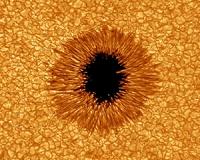 Amazing New Sun Images From NJIT's Big Bear Solar Observatory
Newark NJ (SPX) Aug 26, 2010 NJIT Distinguished Professor Philip R. Goode and the Big Bear Solar Observatory (BBSO) team have achieved "first light" using a deformable mirror in what is called adaptive optics at Big Bear Solar Observatory (BBSO). "This photo of a sunspot is now the most detailed ever obtained in visible light," according to Ciel et l'Espace. In September, the publication, a popular astronomy magazine, ... read more |
|
|
| The content herein, unless otherwise known to be public domain, are Copyright 1995-2010 - SpaceDaily. AFP and UPI Wire Stories are copyright Agence France-Presse and United Press International. ESA Portal Reports are copyright European Space Agency. All NASA sourced material is public domain. Additional copyrights may apply in whole or part to other bona fide parties. Advertising does not imply endorsement,agreement or approval of any opinions, statements or information provided by SpaceDaily on any Web page published or hosted by SpaceDaily. Privacy Statement |


 del.icio.us
 Digg
Digg Reddit
 YahooMyWeb
 Google
 Facebook


