

 |

Bochum, Germany (SPX) Aug 27, 2010 Together with cooperation partners from the U.S., the researchers surrounding Prof. Dr. Martina Havenith (Physical Chemistry II of the RUB) describe their discovery in a so-termed Rapid Communication in the prestigious American chemistry journal, the Journal of the American Chemical Society (JACS). The journal's independent reviewers evaluated the work as one of the top 5% of all submissions.
Better than household antifreeze These so-called anti-freeze proteins work better than any household antifreeze. How they work, however, was still unclear. The Bochum researchers used a special technique, terahertz spectroscopy, to unravel the underlying mechanism. With the aid of terahertz radiation, the collective motion of water molecules and proteins can be recorded. Thus, the working group has already been able to show that water molecules, which usually perform a permanent dance in liquid water, and constantly enter new bonds, dance a more ordered dance in the presence of proteins - "the disco dance becomes a minuet" says Prof. Havenith.
Souvenir from an Antarctic expedition We speak of an extended dynamical hydration shell", says co-author Konrad Meister. "This effect, which prevents ice crystallization, is even more pronounced at low temperatures than at room temperature", adds Prof. Havenith. Nevertheless, to freeze the water, lower temperatures would be necessary. Complexation of the AFP by borate strongly reduces the antifreeze activity. In this case, the researchers also found no change in the terahertz dance. The researchers' results provide evidence for a new model of how AFGPs prevent water from freezing: Antifreeze activity is not achieved by a single molecular binding between the protein and the water, but instead AFP perturbs the aqueous solvent over long distances. The investigation demonstrated for the first time a direct link between the function of a protein and its signature in the terahertz range. The studies were funded by the Volkswagen Foundation.
Share This Article With Planet Earth
Related Links Ruhr-University Bochum Beyond the Ice Age

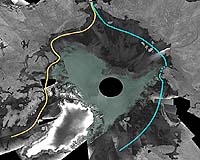 Receding ice could unlock arctic trove
 Helsinki, Finland (UPI) Aug 26, 2010 Receding arctic ice from global warming may open new avenues for tourism and trade and could reveal vast new natural resource reserves, researchers say. The northern ice cover is becoming smaller and thinner, and scientists predict the Arctic Ocean could lose its icecap completely during summertime by the end of the century at the latest, and possibly as early as the 2030s, Finland's He ... read more |
|
|
| The content herein, unless otherwise known to be public domain, are Copyright 1995-2010 - SpaceDaily. AFP and UPI Wire Stories are copyright Agence France-Presse and United Press International. ESA Portal Reports are copyright European Space Agency. All NASA sourced material is public domain. Additional copyrights may apply in whole or part to other bona fide parties. Advertising does not imply endorsement,agreement or approval of any opinions, statements or information provided by SpaceDaily on any Web page published or hosted by SpaceDaily. Privacy Statement |


 del.icio.us
 Digg
Digg Reddit
 YahooMyWeb
 Google
 Facebook


