

 |
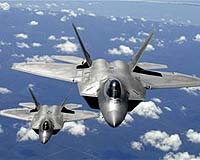
Why The F-22 Remains Vital Part Five
Arlington, Va. (UPI) Mar 19, 2009 What type of military forces will be most in demand to fight the wars of the 21st century? Telling signs are already evident. -- In 2007 Russian Tupolev Tu-95 Bear bombers and Ilyushin Il-78 tankers resumed patrols in the Pacific and Atlantic oceans and near the Arctic Circle after a 15-year absence. -- China's active space program has tested satellite destruction and manned orbital capabilities. -- Russia may have had a hand in cyberattacks on Estonia in 2007 and Georgia in 2008. -- China has been admonished by Germany, Britain and the United States for attempted penetrations of government networks. -- Russia conducted a combined-arms incursion into the former Soviet republic of Georgia in the Caucasus in August 2008, complete with mechanized vehicles, airstrikes and mobile missile forces. In this environment, conventional deterrence will rely heavily on superior air, space and cyberspace capabilities. The United States' big advantage comes from the ability to threaten a successful and persistent airstrike against key targets. Calibrating the flexible deterrent options requires real-time information on threats and options. Job one is to survey and assess the situation. One of the most important aspects of deterrence -- both conventional and nuclear -- is correctly characterizing crises and the actions and posture of adversary military forces. Real-time intelligence, surveillance and reconnaissance is in high demand by the international community as it takes its first steps in considering action during a crisis. Decision-makers want to know what friendly and adversary forces are really doing, where key units are positioned, and how the situation is changing. Reflecting this, U.S. joint doctrine explicitly lists positioning of ISR assets as part of flexible deterrent operations. In the Balkans in the early 1990s, the U.S.-led North Atlantic Treaty Organization set up surveillance and no-fly zones long before committing to further action. Operations against terrorism consume ISR. With current forces, it is easy to picture force options such as a deployment of the Global Hawk unmanned aerial system and other ISR assets, along with fighter forces, to signal resolve and shape a crisis. In Iraq and Afghanistan, the United States and its partners have grown accustomed to a level of ISR unprecedented in warfare. It began with the early use of unmanned aerial systems Predator and Global Hawk in Afghanistan, and has spiraled to the point where a combination of systems can track terrorist movements visually and electronically. ISR is not perfect, but it provides an addictive level of information. Space platforms play a role, but the most sophisticated, sensitive ISR depends on near-complete control of the airspace so that aircraft of all types may operate with impunity.
(United Press International's "Outside View" commentaries are written by outside contributors who specialize in a variety of important issues. The views expressed do not necessarily reflect those of United Press International. In the interests of creating an open forum, original submissions are invited.)
Related Links The latest in Military Technology for the 21st century at SpaceWar.com
 DrCongo signs cluster munitions pact, Laos ratifies it
 United Nations (AFP) March 18, 2009
The Democratic Republic of Congo (DRC) on Wednesday became the 96th country to sign a landmark international treaty banning cluster munitions, while Laos ratified it, becoming the fifth nation to do so. |
|
|

| The content herein, unless otherwise known to be public domain, are Copyright 1995-2007 - SpaceDaily.AFP and UPI Wire Stories are copyright Agence France-Presse and United Press International. ESA Portal Reports are copyright European Space Agency. All NASA sourced material is public domain. Additional copyrights may apply in whole or part to other bona fide parties. Advertising does not imply endorsement,agreement or approval of any opinions, statements or information provided by SpaceDaily on any Web page published or hosted by SpaceDaily. Privacy Statement |
 del.icio.us
 Digg
Digg Reddit
 YahooMyWeb
 Google
 Facebook