|
Will Global Warming Increase Plant Frost Damage
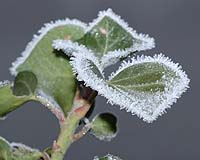
Washington DC (SPX) Mar 04, 2008 Widespread damage to plants from a sudden freeze that occurred across the Eastern United States from 5 April to 9 April 2007 was made worse because it had been preceded by two weeks of unusual warmth, according to an analysis published in the March 2008 issue of BioScience. The authors of the report, Lianhong Gu and his colleagues at the Oak Ridge National Laboratory and collaborators at NASA, the University of Missouri, and the National Oceanic and Atmospheric Administration, found that the freeze killed new leaves, shoots, flowers, and fruit of natural vegetation, caused crown dieback of trees, and led to severe damage to crops in an area encompassing Nebraska, Maryland, South Carolina, and Texas. Subsequent drought limited regrowth. Rising levels of atmospheric carbon dioxide are believed to reduce the ability of some plants to withstand freezing, and the authors of the BioScience study suggest that global warming could lead to more freeze and thaw fluctuations in future winters. This pattern is potentially dangerous for plants because many species must acclimate to cold over a sustained period. Acclimation enables them to better withstand freezes, but unusual warmth early in the year prevents the process. A cold spring in 1996, in contrast to the 2007 event, caused little enduring damage because it was not preceded by unusual warmth. The 2007 freeze is likely to have lasting effects on carbon balance in the region. Plants cannot resorb nutrients from dead tissue that would normally be remobilized within the plants during autumnal senescence, so many nutrients became less available for plants in 2008. Wildlife is expected to have suffered harm from lack of food, and changes to plant architecture could have long-term implications. Gu and his colleagues propose that the 2007 spring freeze should not be viewed as an isolated event, but as a realistic climate-change scenario. Further study of its long-term consequences could help refine scenarios for ecosystem changes as carbon dioxide levels increase and the climate warms. Community Email This Article Comment On This Article Related Links American Institute of Biological Sciences Climate Science News - Modeling, Mitigation Adaptation
 Seafloor Cores Show Tight Bond Between Dust And Past Climates
 New York NY (SPX) Feb 29, 2008
Each year, long-distance winds drop up to 900 million tons of dust from deserts and other parts of the land into the oceans. Scientists suspect this phenomenon connects to global climate-but exactly how, remains a question. Now a big piece of the puzzle has fallen into place, with a study showing that the amount of dust entering the equatorial Pacific peaks sharply during repeated ice ages, then declines when climate warms. |
|
|
| The content herein, unless otherwise known to be public domain, are Copyright Space.TV Corporation. AFP and UPI Wire Stories are copyright Agence France-Presse and United Press International. ESA Portal Reports are copyright European Space Agency. All NASA sourced material is public domain. Additional copyrights may apply in whole or part to other bona fide parties. Advertising does not imply endorsement, agreement or approval of any opinions, statements or information provided by Space.TV Corp on any Web page published or hosted by Space.TV Corp. Privacy Statement |