|
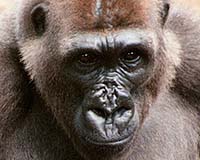
World's Most Endangered Gorilla Fights Back
Bronx NY (SPX) Dec 10, 2007 In the wake of a study that documented for the first time the use of weaponry by Cross River gorillas to ward off threats by humans, the Wildlife Conservation Society announced today new field surveys to better protect this most endangered great ape. The study, published earlier this year in the American Journal of Primatology, found several instances of gorillas throwing sticks and clumps of grass when threatened by people. Gorillas usually flee and rarely charge when encountered by humans. Cross River gorillas are restricted to Nigeria and Cameroon. They number only around 300 individuals, making them the most endangered of the four gorilla sub-species. The Wildlife Conservation Society, which has studied Cross River gorillas since 1999, will begin new field surveys next month in an attempt to catalogue all potential gorilla habitat. The surveys are being funded in part by the U.S. Fish and Wildlife Service. Earlier this year, the Wildlife Conservation Society released an action plan to safeguard Cross River gorillas that included creating additional protected areas and raising awareness of this little known great ape. The observations of weapon-use took place in the proposed Kagwene Gorilla Sanctuary in Cameroon - one of the new protected areas recommended in the report. In 2005 the Wildlife Conservation Society documented the first case of tool use among gorillas when researchers discovered individuals using sticks to check the depth of streams before crossing them. The Wildlife Conservation Society saves wildlife and wild lands through science, international conservation, education and management of the world's largest system of urban parks, led by the flagship Bronx Zoo. With hundreds of scientists at work in over 60 countries, it is a leader in the race to save the last of the wild. Community Email This Article Comment On This Article Related Links Wildlife Conservation Society Darwin Today At TerraDaily.com
 Climate Change Will Significantly Increase Impending Bird Extinctions
 Stanford CA (SPX) Dec 07, 2007
Where do you go when you've reached the top of a mountain and you can't go back down? It's a question increasingly relevant to plants and animals, as their habitats slowly shift to higher elevations, driven by rising temperatures worldwide. The answer, unfortunately, is you can't go anywhere. Habitats shrink to the vanishing point, and species go extinct. |
|
|
| The content herein, unless otherwise known to be public domain, are Copyright Space.TV Corporation. AFP and UPI Wire Stories are copyright Agence France-Presse and United Press International. ESA Portal Reports are copyright European Space Agency. All NASA sourced material is public domain. Additional copyrights may apply in whole or part to other bona fide parties. Advertising does not imply endorsement, agreement or approval of any opinions, statements or information provided by Space.TV Corp on any Web page published or hosted by Space.TV Corp. Privacy Statement |