
 |
 |
 |
 |
 |
 |
 |
 |
 |

 |
ESA Water Mission On Track For Launch
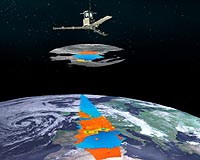
Paris, France (ESA) Feb 16, 2009 Following word from Eurockot that launch of the Earth Explorer SMOS satellite can take place between July and October this year, ESA, CNES and the prime contractor Thales Alenia Space are now making detailed preparations for the last crucial steps before ESA's water mission is placed in orbit. The Soil Moisture and Ocean Salinity (SMOS) satellite has been in storage at Thales Alenia Space's facilities in Cannes, France since May last year awaiting for a third stage of the Rockot launcher to be assigned to the mission and a slot given for launch from the Russian Plesetsk Cosmodrome 800 km north of Moscow. All being well, SMOS will be the second of ESA's Earth Explorer missions to launch after the Gravity field and steady-state Ocean Circulation Explorer (GOCE), which is planned for launch on 16 March 2009. Following news from Eurockot Launch Services that launch will be this summer, a team of SMOS managers and engineers from ESA, CNES and Thales Alenia Space has just returned from Moscow after meeting with their Russian counterparts to discuss aspects of the launch. Now on track for launch, the SMOS team is preparing for the final milestone prior to the satellite being shipped to Plesetsk - the Flight Acceptance Review. The review will take place in May and involves the design, analysis, manufacture and testing being presented to external reviewers, which ensures that nothing critical has been overlooked. The expected outcome is 'consent to ship' - giving the green light to pack up the SMOS satellite and transport it to Russia for launch in the summer. SMOS is the first mission dedicated to measuring both the moisture in soil and salt in the surface waters of the oceans. Mapping soil moisture and ocean salinity, ESA's water mission will further our understanding of the water cycle - key to advancing research into global and regional climate change as well as weather and extreme-event forecasting. Also demonstrating technical innovation, SMOS will carry a completely new type of instrument in space - a microwave imaging radiometer that operates between 1400 - 1427 MHz (L-band). The Microwave Imaging Radiometer using Aperture Synthesis (MIRAS) instrument comprises a central structure and three arms that are deployed shortly after launch. There are 69 antenna-receivers distributed equally over the three arms and central hub which work by measuring microwave radiation emitted from the surface of the Earth. Developed by EADS-CASA in Spain, the MIRAS instrument takes advantage of the fact that moisture in the soil and salt in seawater affect the amount of radiation emitted. The MIRAS instrument is carried on a standard spacecraft platform called Proteus developed by the French space agency CNES. Share This Article With Planet Earth
Related Links SMOS Earth Observation News - Suppiliers, Technology and Application
 NASA Mission Meets The Carbon Dioxide Measurement Challenge
 Pasadena CA (SPX) Feb 12, 2009
The challenge: very precisely measure carbon dioxide in Earth's atmosphere all over the world, especially near Earth's surface. |
|
|

| The content herein, unless otherwise known to be public domain, are Copyright 1995-2007 - SpaceDaily.AFP and UPI Wire Stories are copyright Agence France-Presse and United Press International. ESA Portal Reports are copyright European Space Agency. All NASA sourced material is public domain. Additional copyrights may apply in whole or part to other bona fide parties. Advertising does not imply endorsement,agreement or approval of any opinions, statements or information provided by SpaceDaily on any Web page published or hosted by SpaceDaily. Privacy Statement |
 del.icio.us
 Digg
Digg Reddit
 YahooMyWeb
 Google
 Facebook