
 |
 |
 |
 |
 |
 |
 |
 |
 |

 |
GKSS Scientists Refute Argument Of Climate Sceptics
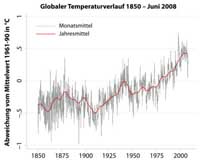
Geesthacht, Denmark (SPX) Jan 14, 2009 Scientists at the GKSS Research Centre of Geesthacht and the University of Bern have investigated the frequency of warmer than average years between 1880 and 2006 for the first time. The result: the observed increase of warm years after 1990 is not a statistical accident. The results will now be published in the journal "Geophysical Research Letters". Between 1880 and 2006 the average global annual temperature was about 15 degrees C. However, in the years after 1990 the frequency of years when this average value was exceeded increased. The GKSS Research Centre asks: is it an accident that the warmest 13 years were observed after 1990, or does this increased frequency indicate an external influence?
Calculating the likelihood The fact that the 13 warmest years since 1880 could have accured by accident after 1990 corresponds to a likelihood of no more than 1:10,000. These likelihood can be illustrated by using the game of chance "heads or tails": the likelihood is the same as 14 heads in a row.
Climate is more complicated than a game The natural sequence of warm and cold years no longer functions according to the simple principle of "zero or one", explains the GKSS scientist Dr. Eduardo Zorita about the challenges of his calculations, because the climate system possesses some inertia. An example: After a warm year milder years tend to follow, since the oceans have stored some heat. This natural inertia must also be included in the calculations. "Our study is pure statistical nature and can not attribute the increase of warm years to individual factors, but is in full agreement with the results of the IPCC that the increased emission of green house gases is mainly responsible for the most recent global warming", says Zorita in summary. Original title of publication: Zorita, E., T. F. Stocker, and H. von Storch (2008), How unusual is the recent series of warm years?, Geophys. Res. Lett., 35, L24706, doi:10.1029/2008GL036228 Share This Article With Planet Earth
Related Links GKSS Research Centre of Geesthacht Climate Science News - Modeling, Mitigation Adaptation
 The earth's magnetic field impacts climate: Danish study
 Copenhagen (AFP) Jan 12, 2009
The earth's climate has been significantly affected by the planet's magnetic field, according to a Danish study published Monday that could challenge the notion that human emissions are responsible for global warming. |
|
|

| The content herein, unless otherwise known to be public domain, are Copyright 1995-2007 - SpaceDaily.AFP and UPI Wire Stories are copyright Agence France-Presse and United Press International. ESA Portal Reports are copyright European Space Agency. All NASA sourced material is public domain. Additional copyrights may apply in whole or part to other bona fide parties. Advertising does not imply endorsement,agreement or approval of any opinions, statements or information provided by SpaceDaily on any Web page published or hosted by SpaceDaily. Privacy Statement |
 del.icio.us
 Digg
Digg Reddit
 YahooMyWeb
 Google
 Facebook