
 |
 |
 |
 |
 |
 |
 |
 |
 |

 |
Launch Cover Placed Over Kepler
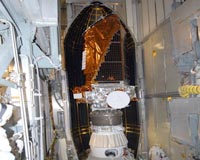
Cape Canaveral FL (SPX) Mar 02, 2009 With the Kepler spacecraft secured tightly to the top of a Delta II rocket, technicians placed the two-piece nose cone around the observatory as they continued working toward a launch no earlier than March 6 from Cape Canaveral Air Force Station on Florida's Atlantic coast. The payload fairing, also called a shroud, is a protective cover that shields the spacecraft as the rocket zooms thorugh the lower atmosphere. Heat builds up on the surface of the rocket during the acceleration into space because of the friction with the air. The fairing is split in two pieces that open and fall away when the rocket reaches layers of very thin air, which do not threaten the spacecraft. It is the first mission with the ability to find planets like Earth - rocky planets that orbit sun-like stars in a warm zone where liquid water could be maintained on the surface. Liquid water is believed to be essential for the formation of life. "Kepler is a critical component in NASA's broader efforts to ultimately find and study planets where Earth-like conditions may be present," said Jon Morse, the Astrophysics Division director at NASA Headquarters in Washington. "The planetary census Kepler takes will be very important for understanding the frequency of Earth-size planets in our galaxy and planning future missions that directly detect and characterize such worlds around nearby stars." The Kepler spacecraft will watch a patch of space for 3.5 years or more for signs of Earth-sized planets moving around stars similar to the sun. The patch that Kepler will watch contains about 100,000 stars like the sun. Using special detectors similar to those used in digital cameras, Kepler will look for slight dimming in the stars as planets pass between the star and Kepler. The Kepler's place in space will allow it to watch the same stars constantly throughout its mission, something observatories like Hubble cannot do. Share This Article With Planet Earth
Related Links Kepler Lands Beyond Beyond - extra solar planets - news and science Life Beyond Earth
 Kepler Attached To Rocket
 Cape Canaveral FL (SPX) Feb 26, 2009
The Kepler spacecraft has been lifted into place and attached to the Delta II rocket that will launch it into space. The work is on schedule to launch the observatory on March 5 from Cape Canaveral Air Force Station on Florida's Atlantic coast. |
|
|

| The content herein, unless otherwise known to be public domain, are Copyright 1995-2007 - SpaceDaily.AFP and UPI Wire Stories are copyright Agence France-Presse and United Press International. ESA Portal Reports are copyright European Space Agency. All NASA sourced material is public domain. Additional copyrights may apply in whole or part to other bona fide parties. Advertising does not imply endorsement,agreement or approval of any opinions, statements or information provided by SpaceDaily on any Web page published or hosted by SpaceDaily. Privacy Statement |
 del.icio.us
 Digg
Digg Reddit
 YahooMyWeb
 Google
 Facebook