
 |
 |
 |
 |
 |
 |
 |
 |
 |

 |
Predicted Planet Seen - First Since Neptune 162 Years Ago
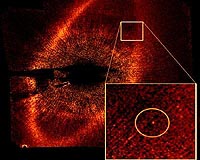
Rochester NY (SPX) Dec 11, 2008 In 2006, astronomer Alice Quillen of the University of Rochester predicted that a planet of a particular size and orbit must lie within the dust of a nearby star. That planet has now been photographed by the Hubble Space Telescope, making it only the second planet ever imaged after an accurate prediction. The only other planet seen after an accurate prediction was Neptune, discovered more than 160 years ago. "It's remarkable," says Eugene Chiang, associate professor of astronomy at the University of California at Berkeley, and part of the team that imaged the new planet. "Alice saw the way the inner edge of the dust ring cut off sharply and recognized that a planet likely orbited just inside. The orbit we found was amazingly close to Alice's prediction." "This is a terrific achievement that showcases Alice's many talents," says Nick Bigelow, chair of the Department of Physics and Astronomy at the University of Rochester. "Just think, it has been over 160 years since the presence of a planet has been inferred and so quickly imaged, and that was a planet orbiting our own Sun, not a star hundreds of trillions of miles away. Extraordinary!" On November 13, Chiang and his colleagues announced they had imaged a planet around Fomalhaut, a bright, nearby star surrounded by a ring of dust. One of the planets matches the planet Quillen predicted in 2006. Along with three other planets imaged concurrently by another team, this is the first planet outside of our solar system to be directly imaged. Neptune, imaged in 1846, was inferred by its effect on the orbit of Uranus three years earlier, and marked the first time a planet was predicted before it was actually seen. In 2004, astronomers at the University of Washington predicted the existence of a planet around a sun-like star 212 light years away. The planet was confirmed in 2007 using a technique called radial velocity, but its image has not been resolved the way the Fomalhaut planet's has. Quillen has worked for years to understand the way planets shape stellar dust disks like the one surrounding Fomalhaut. She is now one of the world's experts in predicting planet size and position from the features of a star's dust ring. She used Hubble Space Telescope images that revealed that the ring of dust surrounding Fomalhaut was off-center. The images were also clear enough to show that the ring itself had a surprisingly sharp edge. That sharp inside edge, Quillen calculated, demanded that a relatively small, Neptune-size planet was tucked right up against the inner side of the ring, using its gravity to toss out of orbit the dust in the area. According to Quillen's calculations, the ring is elliptical because the planet's orbit around Fomalhaut is also elliptical-a curiosity in such a young system. When stars form from a giant cloud of gas and dust, the angular momentum of the cloud carries over to all the objects that form from the cloud, including new planets. Those new planets should initially orbit in roughly circular paths-not elliptical ones. Fomalhaut's ring is offset by 1.4 billion miles, more than 15 times the distance from the Earth to the Sun, suggesting the hidden planet's orbit is also tremendously skewed. Quillen continues to strengthen her planet-ring interaction models. Treating a dust ring like a hydrodynamic structure, for instance, is necessary for younger stars whose dust is relatively fine and acts more like a fluid-while the physics of dust particle collision become more important in older ring systems where the dust has begun clumping into larger bodies, says Quillen. Share This Article With Planet Earth
Related Links University of Rochester Lands Beyond Beyond - extra solar planets - news and science Life Beyond Earth
 Hubble telescope finds carbon dioxide on distant planet
 Washington (AFP) Dec 9, 2008
NASA's Hubble Space Telescope has discovered both carbon dioxide and carbon monoxide in the atmosphere of a distant planet, in a key step for finding extraterrestrial life, the space agency said Tuesday. |
|
|

| The content herein, unless otherwise known to be public domain, are Copyright 1995-2007 - SpaceDaily.AFP and UPI Wire Stories are copyright Agence France-Presse and United Press International. ESA Portal Reports are copyright European Space Agency. All NASA sourced material is public domain. Additional copyrights may apply in whole or part to other bona fide parties. Advertising does not imply endorsement,agreement or approval of any opinions, statements or information provided by SpaceDaily on any Web page published or hosted by SpaceDaily. Privacy Statement |
 del.icio.us
 Digg
Digg Reddit
 YahooMyWeb
 Google
 Facebook