
 |
 |
 |
 |
 |
 |
 |
 |
 |

 |
Robots Remove UXO From Training Ranges
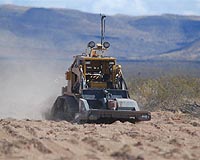
Washington DC (SPX) Feb 26, 2009 Robotic technologies were used to detect and remove unexploded ordnance from training ranges at Fort Bliss, Texas, Feb. 10 in a demonstration sponsored by the U.S. Army Environmental Command. Experts from the Army's Environmental Command joined bloggers for a special roundtable discussion on how the demonstration went and how robotics could improve safety, efficiency, and provide cost-savings in UXO removal. "There's two things that we're doing," said Kimberly Watts of the Environmental Command. "We wanted to demonstrate to make sure that the equipment was actually working the way we were hoping that it would. It did. Yes, definitely for smaller areas. Yes, we need to scale up for the larger areas, larger ranges, but, you know, there are applications for it right now." The command evaluated two basic robotics systems the Air Force Research Lab has developed: the All-Purpose Remote Transport System, or ARTS, and the Automated Ordnance Excavator, known as AOE. The systems are remotely operated with attachments that can be added to aid with brush removal and extraction, said Gene Fabian, Range Sustainment Program Manager, U.S. Army Aberdeen Test Center. A third unit that has been demonstrated previously is an Advanced Mobility Research and Development System, or AMRADS unit. It is an autonomous unit that is used frequently for physical surveying because of its ability to run on its own based on plugged-in boundaries, Fabian said. Fabian likened AMRADS to the Zamboni of hockey fame, saying its general pattern is very similar to what you'll see on the ice rink. But rather than washing away scuffs and chips, AMRADS will identify metallic anomalies in the area surveyed, before and after removal operations. "We typically use that Zamboni pattern to make sure we get complete coverage," said Fabian. "And the data for our geophysical detection devices is very clean because it's very precise, fast: it tells you where to go. It doesn't waddle and wander all over the site like a human being would be, so we actually get much better data quality by using the robotic system." Speed is critical for the U.S. Army, which currently has many areas in need of surveying and a limited supply of UXO technicians. They're looking at robotic removal options to make a big difference as they clear and maintain range sites, Fabian said. But speed isn't the only factor - costs are also expected to be lower with the robotic technologies, according to Watts. They're currently using off-the-shelf technologies fitted with the robotics package. Combine that with the time savings and increased safety, robotics UXO removal could potentially benefit the Army's Range Modernization Program as well as Army clean up, Watts said. Share This Article With Planet Earth
Related Links US Army Environmental Command The latest in Military Technology for the 21st century at SpaceWar.com
 Costly US weapons face budget cuts under Obama
 Washington (AFP) Feb 25, 2009
Hi-tech fighter aircraft, new warships and missile defense projects are all potential targets for big cuts in the US defense budget as the American military faces a new era of limits under President Barack Obama. |
|
|

| The content herein, unless otherwise known to be public domain, are Copyright 1995-2007 - SpaceDaily.AFP and UPI Wire Stories are copyright Agence France-Presse and United Press International. ESA Portal Reports are copyright European Space Agency. All NASA sourced material is public domain. Additional copyrights may apply in whole or part to other bona fide parties. Advertising does not imply endorsement,agreement or approval of any opinions, statements or information provided by SpaceDaily on any Web page published or hosted by SpaceDaily. Privacy Statement |
 del.icio.us
 Digg
Digg Reddit
 YahooMyWeb
 Google
 Facebook