
 |
 |
 |
 |
 |
 |
 |
 |
 |

 |
Russian military satellite in orbit after launch
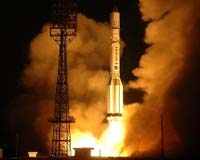
Moscow (UPI) Feb 28, 2009 A Russian military satellite is now in orbit above the Earth after being launched with a Proton-K heavy carrier rocket Saturday, an official says. A Space Forces spokesman, Lt. Col. Alexei Zolotukhin, said the satellite successfully separated from the Russian rocket after being launched from the Baikonur space center, RIA Novosti reported. "The separation of the satellite from the upper stage took place in a normal mode," Zolotukhin said. The Baikonur center, located in the central Asian Republic of Kazakhstan, is one of two sites Russia uses to launch rockets and test-fire ballistic missiles. RIA Novosti said the other site is northwest Russia's Plesetsk space center. Saturday's launch marked the most recent use of the Proton-K heavy carrier rocket, which was first used in 1968. There have been several thousand launches of the rocket since it was adopted. There are plans to use the rocket to deliver International Space Station modules to the near-earth orbit. Russia currently uses two launch sites for space carrier rockets and ballistic missiles tests: the Baikonur space center in the Central Asian Republic of Kazakhstan, which it has leased since the collapse of the Soviet Union, and the Plesetsk space center in northwest Russia. Share This Article With Planet Earth
Related Links Read the latest in Military Space Communications Technology at SpaceWar.com
 Boeing Delivers First Communications Payload To MUOS Prime Contractor
 El Segundo CA (SPX) Feb 18, 2009
Boeing has delivered the first Legacy Communications payload and the first digital channelizer to Lockheed Martin in support of the U.S. Navy's new Mobile User Objective System (MUOS) communications system. The Legacy Communications payload allows the Navy to use existing UHF ground- and space-based communications systems. |
|
|

| The content herein, unless otherwise known to be public domain, are Copyright 1995-2007 - SpaceDaily.AFP and UPI Wire Stories are copyright Agence France-Presse and United Press International. ESA Portal Reports are copyright European Space Agency. All NASA sourced material is public domain. Additional copyrights may apply in whole or part to other bona fide parties. Advertising does not imply endorsement,agreement or approval of any opinions, statements or information provided by SpaceDaily on any Web page published or hosted by SpaceDaily. Privacy Statement |
 del.icio.us
 Digg
Digg Reddit
 YahooMyWeb
 Google
 Facebook