
 |
 |
 |
 |
 |
 |
 |
 |
 |

 |
Stellar Cannibalism Key To Formation Of Overweight Stars
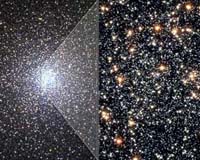
Southampton UK (SPX) Jan 15, 2009 Researchers have discovered that the mysterious overweight stars known as blue stragglers are the result of 'stellar cannibalism' where plasma is gradually pulled from one star to another to form a massive, unusually hot star that appears younger than it is. The process takes place in binary stars - star systems consisting of two stars orbiting around their common centre of mass. This helps to resolve a long standing mystery in stellar evolution. The research, which is part funded by the UK's Science and Technology Facilities Council (STFC) and carried out by scientists at Southampton University and the McMaster University in Canada, is published in the journal Nature on Thursday 15 January. Blue stragglers are found throughout the Universe in globular clusters - collections of about 100, 000 stars, tightly bound by gravity. According to conventional theories, the massive blue stragglers found in these clusters should have died long ago because all stars in a cluster are born at the same time and should therefore be at a similar phase. These massive rogue stars, however, appear to be much younger than the other stars and are found in virtually every observed cluster. Dr Christian Knigge from Southampton University, who led the study, comments: "The origin of blue stragglers has been a long-standing mystery. The only thing that was clear is that at least two stars must be involved in the creation of every single blue straggler, because isolated stars this massive simply should not exist in these clusters." Professor Alison Sills from the McMaster University explains further: "We've known of these stellar anomalies for 55 years now. Over time two main theories have emerged: that blue stragglers were created through collisions with other stars; or that one star in a binary system was 'reborn' by pulling matter off its companion." The researchers looked at blue stragglers in 56 globular clusters. They found that the total number of blue stragglers in a given cluster did not correlate with predicted collision rate - dispelling the theory that blue stragglers are created through collisions with other stars. They did, however, discover a connection between the total mass contained in the core of the globular cluster and the number of blue stragglers observed within in. Since more massive cores also contain more binary stars, they were able to infer a relationship between blue stragglers and binaries in globular clusters. They also showed that this conclusion is supported by preliminary observations that directly measured the abundance of binary stars in cluster cores. All of this points to "stellar cannibalism" as the primary mechanism for blue straggler formation. Dr Knigge says: "This is the strongest and most direct evidence to date that most blue stragglers, even those found in the cluster cores, are the offspring of two binary stars. In our future work we will want to determine whether the binary parents of blue stragglers evolve mostly in isolation, or whether dynamical encounters with other stars in the clusters are required somewhere along the line in order to explain our results." This discovery comes as the world celebrates the International Year of Astronomy in 2009. Share This Article With Planet Earth
Related Links - Lands Beyond Beyond - extra solar planets - news and science Life Beyond Earth
 First glimpse of exoplanet atmosphere from Earth
 Paris (AFP) Jan 14, 2009
Two separate teams of scientists reported Wednesday the first-ever detection from Earth of the atmosphere of planets outside our solar system. |
|
|

| The content herein, unless otherwise known to be public domain, are Copyright 1995-2007 - SpaceDaily.AFP and UPI Wire Stories are copyright Agence France-Presse and United Press International. ESA Portal Reports are copyright European Space Agency. All NASA sourced material is public domain. Additional copyrights may apply in whole or part to other bona fide parties. Advertising does not imply endorsement,agreement or approval of any opinions, statements or information provided by SpaceDaily on any Web page published or hosted by SpaceDaily. Privacy Statement |
 del.icio.us
 Digg
Digg Reddit
 YahooMyWeb
 Google
 Facebook