
 |
 |
 |
 |
 |
 |
 |
 |
 |

 |
Timing is perfect, but money woes plague electric car maker Think
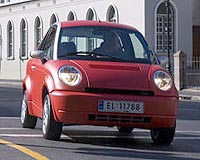
Aurskog, Norway (AFP) Dec 17, 2008 Despite a winning and timely concept amid global climate concerns, Norwegian electric car maker Think may see its dreams come to a screeching halt due to a lack of financing. Only two months after it launched production of its hitherto sole model, the Think City, the company has decided to temporarily lay-off more than half of its 200 employees until the end of January. It is in dire need of cash to pay suppliers, who are exercising caution and demanding up-front payment, and has asked the Norwegian government for either a line of credit, loan guarantees, or a capital injection in exchange for a stake in the company. But to no avail, so far. "We are in a very serious situation," the group's Australian chief executive Richard Canny -- a recent defector from beleaguered US carmaker Ford -- told reporters. "Think's growth has been affected by the global financial crisis with our ability to raise fresh capital severely impacted," he told AFP. The Norwegian carmaker, once owned by Ford, is small but ambitious: it aims to become the world leader in electric cars. In 2009, it plans to double its annual production capacity to 10,000 vehicles and conquer new markets. The compact, plastic two-seater with neat lines, a maximum speed of 110 kilometres (68 miles) an hour and a range of 180 kilometres (110 miles), is only rolling on Oslo roads for now. The Norwegian capital is ideal for the small car, with its relatively numerous recharging stations and regulations that offer electric car drivers the use of public transport lanes, free parking and free passage in toll areas. But Think also planned to roll into other European cities next year, starting with Scandinavian neighbours Copenhagen and Stockholm, and was set to decide in 2009 whether to take on the North American market. "Without fresh capital, we cannot continue our expansion plans," Canny lamented. Contrary to the Big Three carmakers in the United States -- Chrysler, Ford and General Motors -- who cannot find buyers for their gas-guzzling models, Think's problem is not a lack of buyers but a lack of financing for production. According to Norwegian media reports, the group, which has gone bankrupt twice in its 18 tumultuous years of existence, needs some 280 million kroner (30 million euros, 40 million dollars). Its latest woes are a heavy blow for Think's workers, many of whom are former Saab or Volvo employees who have fled the embattled auto industry in neighbouring Sweden for what they believed was the carmaker of the future. On the assembly line at the company's plant in Aurskog, some 50 kilometres (30 miles) east of Oslo, at least 60 percent of the workers are Swedes. "In the past few weeks I've received an unbelievable number of applications from Sweden," plant foreman Arne Degermosse, himself a Swede, told visiting reporters recently. A Swede of Egyptian origin, Shady Elghobary, is one of those who has crossed the border from Sweden to Norway, leaving behind his wife and two-year-old child in Saab's hometown of Trollhaettan to work in Aurskog, returning to visit his family in Sweden on weekends. "I came here two months ago when we found out that my former employer Saab was going to cut jobs," he said, just days before Think announced its plans for temporary lay-offs. "I have no choice. I have to work to support my family," he said. Share This Article With Planet Earth
Related Links Car Technology at SpaceMart.com
 Troubled automaker GM opens new plant in China
 Beijing (AFP) Dec 17, 2008
Beleaguered auto giant General Motors opened a new joint venture factory in northeast China Wednesday, as it sharply cut back capacity in the United States due to the rapid economic downturn. |
|
|

| The content herein, unless otherwise known to be public domain, are Copyright 1995-2007 - SpaceDaily.AFP and UPI Wire Stories are copyright Agence France-Presse and United Press International. ESA Portal Reports are copyright European Space Agency. All NASA sourced material is public domain. Additional copyrights may apply in whole or part to other bona fide parties. Advertising does not imply endorsement,agreement or approval of any opinions, statements or information provided by SpaceDaily on any Web page published or hosted by SpaceDaily. Privacy Statement |
 del.icio.us
 Digg
Digg Reddit
 YahooMyWeb
 Google
 Facebook